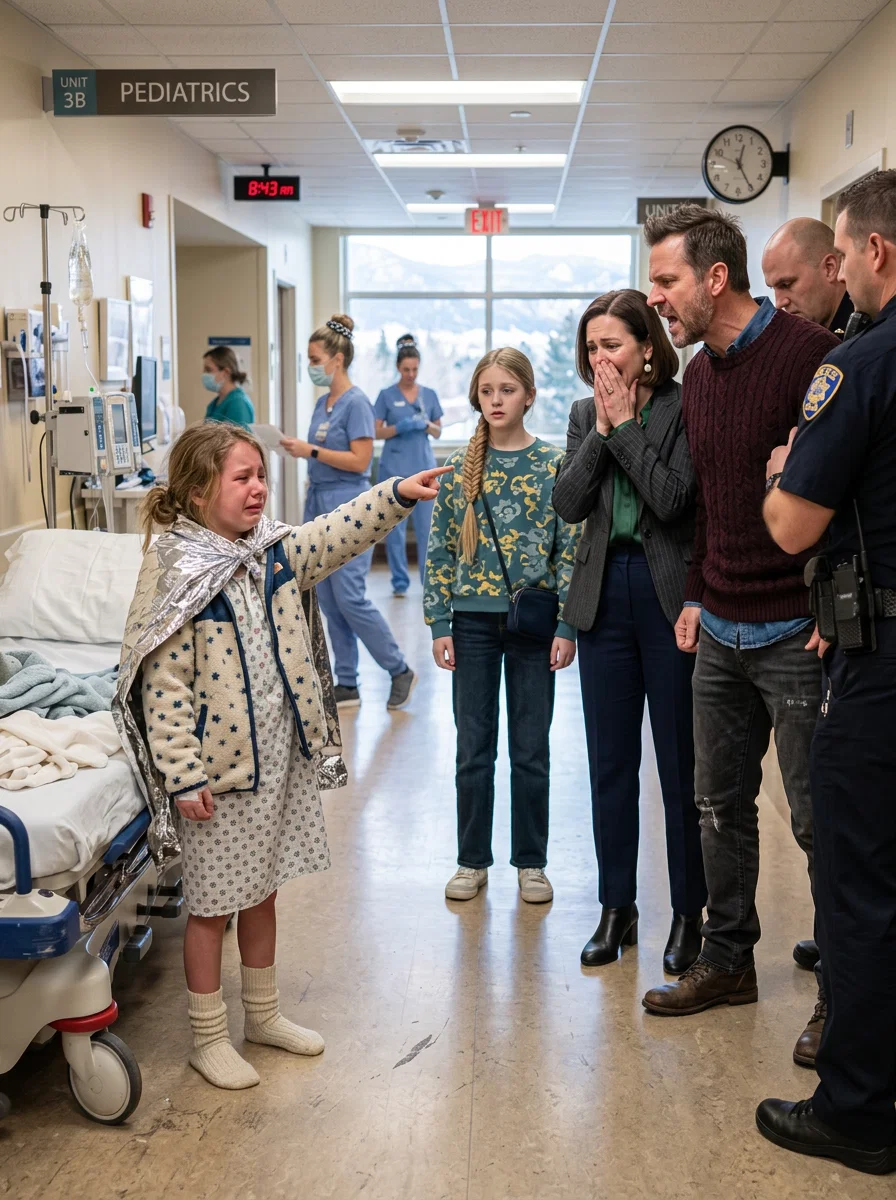
I was eight years old when my parents a.ban.don.ed me alone on Pine Crest Ridge outside Aspen, Colorado.
It happened after I complained that my boots were scraping my heels raw.
My father, Richard Hayes, stopped along the trail, stared at me with the same annoyed expression he wore whenever I interrupted anything concerning my older sister, Claire, and said, “If she’s old enough to complain, she’s old enough to walk.”
My mother, Melissa, laughed awkwardly. Claire, eleven, rolled her eyes.
Then they walked off.
At first, I assumed it was punishment. I believed they would hide around a bend and return after I cried. I shouted until my throat burned, but the trail remained empty.
By sunset, the temperature fell sharply.
I discovered an unlocked maintenance shed beside an old ski access road. Inside were a d@maged shovel, bags of salt, and a thin emergency blanket tucked inside a cracked plastic cabinet. I wrapped myself in it and spent the night hearing the wind pound against the metal walls.
Meanwhile, my parents drove three hours home to Denver.
They never reported me missing.
According to what I discovered later, my father assumed I would “find a ranger and learn a lesson.”
My mother asked him twice whether they should go back. He refused. Claire apparently remained silent.
The following morning, a county road worker named Daniel Ruiz noticed the shed door swinging in the wind.
He discovered me inside, dehydrated, trembling, and unable to stand properly because both heels were bl33ding.
Daniel called 911.
At the hospital, a nurse repeatedly asked for my parents’ phone number. I knew it from memory.
Nobody answered.
Police officers were already waiting outside my parents’ house when they eventually returned from breakfast.
The horrifying part was not that their daughter had survived one night alone.
It was what the officers uncovered after entering the house.
My parents had packed Claire’s bedroom for an upcoming private-school transfer.
Inside the kitchen trash, detectives discovered handwritten notes my mother had discarded. One read, “Maybe after this weekend Emma will finally stop ruining every trip.”
Another said, “Richard thinks one night outside might scare the attitude out of her.”
The officers also discovered my backpack in the garage.
My medication, water bottle, sweater, and emergency whistle remained inside it.
They had not simply forgotten me.
They had planned to leave me without the things that might have kept me safe.
And when my father opened the front door for two deputies, his first question was not whether I was alive.
He asked, “How much trouble are we in?”
By the time my parents arrived at the hospital, I had already repeated the same story three times.
First to Daniel Ruiz, the road worker who rescued me. Then to Deputy Karen Whitmore. Then to a child-protection investigator named Leah Morgan.
Each time, I attempted to make my parents sound less cruel than they had been.
I said perhaps they thought I was walking behind them. I said perhaps Dad believed another family remained on the trail. I said Mom probably did not realize my backpack was in the garage.
Leah did not challenge me. She simply asked, “Emma, did anyone tell you where to go after they walked away?”
“No.”
“Did anyone tell you when they would be coming back?”
“No.”
“Did they give you food, water, a phone, or a jacket?”
“No.”
That was when I quit trying to explain it for them.
My mother arrived first. She hurried into the hospital room crying, but a deputy stopped her before she reached my bed. I remember staring at her expensive cream-colored coat and wondering why she had taken it to the mountains while my sweater had remained at home.
“Emma!” she cried. “Baby, we were terrified.”
Deputy Whitmore immediately asked, “When did you become terrified?”
My mother froze.
She had no response that made sense.
My father arrived several minutes afterward with an attorney already on speakerphone.
He demanded to know why officers had entered the house.
He insisted the notes were jokes taken out of context and claimed they had expected me to walk downhill toward the staffed visitor center.
There was one issue.
The visitor center had been closed for renovations for six weeks.
A sign announcing the closure stood near the parking area where my father had left the rental car.
Police obtained surveillance footage from a gas station forty minutes from the ridge.
The video showed my parents, with Claire sitting in the back seat, purchasing coffee and snacks less than an hour after a.ban.don.ing me. My mother bought three bottles of water.
Not four.
That detail eventually mattered more to me than those notes.
Three waters meant they were no longer thinking about us as a family of four.
At least not during that night.
Child Protective Services placed me temporarily with my mother’s younger sister, Aunt Rebecca, who lived in Aurora. Claire was sent there too, although she hardly looked at me during the drive.
For three days, she remained silent.
Then, late one evening, she appeared in the doorway of the room where I was sleeping.
“I knew,” she whispered.
I sat upright.
“Knew what?”
“That they planned to leave you.”
My stomach tightened.
Claire started crying before she finished speaking. She told me Dad had discussed the plan over breakfast that morning. He had said I needed to “break the habit of making everything difficult.” Mom had protested at first, but only because she worried somebody might see them.
Claire had been promised a new phone if she did not interfere.
“Why didn’t you warn me?” I asked.
She wiped her face using both hands.
“I thought they’d come back.”
It was not an apology. Not yet.
The criminal case progressed quickly after Claire repeated that statement to investigators with Aunt Rebecca and a child advocate present. My parents were charged with felony child abuse and reckless en.dan.ger.ment. Their attorneys argued that they had made a terrible parenting decision, not an effort to seriously harm me.
The prosecutors did not have to prove that they wanted me dead.
They only had to show that two adults knowingly a.ban.don.ed an eight-year-old child in d@ngerous conditions without essential supplies.
For the first time in my life, adults beyond my family were treating what happened to me as something serious.
And for the first time, my parents could not control what everyone else was permitted to call it.
The weeks following Pine Crest Ridge changed the shape of our family faster than I could comprehend.
My parents were released on bond with strict instructions not to contact me directly.
They were permitted supervised visits with Claire because investigators had found no evidence that she had been physically endangered, but Aunt Rebecca became my temporary guardian.
For the first time, I lived inside a house where nobody compared my grades, clothes, appetite, or moods with my sister’s.
That should have felt peaceful.
Instead, I kept expecting to be sent back.
Every car door outside made my body tense. Every phone call after dinner made me wonder whether some judge had decided that what happened was not serious enough to matter.
Aunt Rebecca noticed.
One evening, while she prepared spaghetti, I asked, “If they apologize, do I have to go home?”
She switched off the burner before answering.
“No one is making that decision based solely on an apology.”
“What if they tell the judge I’m difficult?”
“You are eight,” she said. “You’re allowed to be difficult sometimes.”
I began crying so suddenly that I em.bar.ras.sed myself.
Rebecca did not tell me to stop.
My parents eventually accepted plea agreements rather than take their chances at trial. My father pleaded guilty to felony child abuse resulting in serious risk of !njury. My mother pleaded guilty to a reduced felony child-neglect charge after prosecutors determined that Richard had created most of the plan, although she had knowingly participated.
The judge reviewed photographs of my feet, the weather report from that night, the closed visitor center, the notes found in our kitchen trash, and the gas-station footage.
Then Claire testified.
She was twelve when the sentencing hearing finally took place.
Her voice trembled when she described breakfast on the morning of our hike.
“Dad said Emma always got attention by complaining,” she told the court. “He said if she complained on the ridge, we should keep walking. Mom asked how long. Dad said long enough to scare her.”
The prosecutor asked, “Did anyone say Emma would have a phone?”
“No.”
“Food?”
“No.”
“Water?”
Claire swallowed. “No.”
“Did you understand she might still be there after dark?”
Claire looked toward our parents.
“Yes.”
My father stared down at the table.
My mother cried.
For years, I remembered that moment as the first time Claire had chosen me over them. Later, as I grew older, I understood it differently. She had been a child too. She had been rewarded for agreeing with our parents and punished emotionally whenever she questioned them.
Telling the truth in court did not erase what she had done, but it was the first thing she did that actually cost her something.
My father received eighteen months in county jail followed by probation and required parenting and anger-management programs. My mother received probation, community service, and mandatory counseling.
The exact sentences disappointed several people around us, especially Aunt Rebecca, but the family-court consequences continued much longer.
My parents lost custody of me.
Rebecca became my permanent legal guardian.
At first, my parents challenged that decision aggressively. Dad claimed Rebecca had man!pulated me. Mom sent lengthy letters through attorneys about reunification and forgiveness. Some of those letters contained apologies. Others contained explanations.
I learned to hate explanations.
Dad wrote that he had been raised by a strict father and believed fear created resilience.
Mom wrote that she had spent years attempting to preserve peace in the marriage.
Neither explanation answered the question that mattered most to me: why had keeping peace with him mattered more than keeping me safe?
Therapy helped me stop asking that question as though there were some hidden answers capable of fixing everything.
There was simply a choice.
They had made theirs.
Claire and I faced a harder road.
For almost a year, I barely spoke to her unless necessary. We lived in neighboring bedrooms at Rebecca’s house because the court eventually approved Claire living there full-time too. Our parents’ legal problems, public attention, and increasing resentment toward her testimony had damaged their relationship with her as well.
One Saturday morning, I discovered Claire sitting on the back steps holding the silver phone Dad had bought her after the trip.
She held it toward me.
“I hate this thing.”
I did not take it.
“So throw it away.”
“I tried.”
“Then why do you still have it?”
“Because I think I deserve to look at it.”
That answer made me angrier than any excuse would have.
“You think feeling bad helps me?”
“No.”
“Then stop making this about how bad you feel.”
Claire flinched.
I had never talked to her that way before.
She nodded and set the phone beside her.
“What do you want me to do?”
“I don’t know.”
That was the truth.
I was nine. I did not have a sophisticated understanding of forgiveness. I only knew that I did not want another apology followed by a demand that I make the person apologizing feel better.
So Claire stopped asking me for forgiveness.
Instead, she changed little things.
When relatives complimented her and overlooked me, she redirected the conversation.
When our grandmother said Dad had “gone too far but meant well,” Claire stood up from the dinner table and said, “He left an eight-year-old on a mountain.”
When classmates discovered old local news stories about our family and whispered about me, Claire never told me to ignore them. She walked alongside me.
It took years before I could trust her without remembering the ridge.
By high school, we were close, though not in the effortless way sisters in movies always seemed to be close. We had rules. She did not speak on my behalf. I did not pretend our past had vanished. If either of us was angry, we said it before resentment had enough time to harden.
Our parents stayed together for another four years.
Then Mom filed for divorce.
She started contacting me more carefully after that, through Rebecca at first. Her messages grew shorter. She stopped trying to defend herself. When I was sixteen, I agreed to meet her at a coffee shop in Denver.
She looked older than I remembered.
For several seconds, neither one of us spoke.
Finally she said, “I’m not going to ask you to call me Mom.”
I stared down at the lid of my hot chocolate.
“Okay.”
“I’m also not going to tell you your father made me do it.”
That caused me to look up.
She continued.
“He planned it. I agreed to it. I could have stopped it before the hike. I could have turned around. I could have called the police when we got home. I did none of those things.”
I waited for the word but.
It never came.
“I chose being scared of conflict with him instead of protecting you,” she said. “That is the truth.”
I did not forgive her that afternoon.
But for the first time, I believed her.
My relationship with my father never healed.
He contacted me twice after his probation ended. The first time, he mailed a birthday card containing a lengthy letter about how the criminal case had ru!ned his career. The second time, when I was nineteen, he asked Claire for my email address because he wanted to “clear up misconceptions.”
She refused to give it to him.
Years later, I discovered that he had moved to Arizona and remarried. I felt less than I thought I would.
The ridge stayed with me in quieter ways.
I hated hiking for many years. I checked locks constantly. I always carried water, a battery pack, and a small emergency kit inside my car.
When friends changed plans without informing me, I sometimes felt pan!cked before logic caught up.
But Pine Crest Ridge did not become the conclusion of my childhood.
Rebecca made certain of that.
She taught me how to drive. She attended parent-teacher conferences. She sat in the front row when I graduated from college with a social work degree. Daniel Ruiz, the man who discovered me in the shed, attended that graduation too.
I had remained in contact with him through birthday cards and occasional lunches.
After the ceremony, he gave me a small package.
Inside was an emergency whistle.
I laughed when I opened it.
“That’s dark,” I told him.
“I figured you could handle the dark.”
“I can.”
He smiled. “I know.”
At twenty-seven, I started working with a county child-advocacy center in Colorado. I did not choose the job because I wanted to transform my life into a lesson. I chose it because I remembered how hard it had been to tell the truth while continuing to love the people who had hurt me.
Children rarely explain their families in neat categories.
Neither did I.
Claire became an architectural engineer and relocated to Seattle. We called each other every Sunday. She married at thirty and asked me to serve as her maid of honor. Before the ceremony, while we were alone together in the dressing room, she held my hand.
“I used to think the worst thing I ever did was stay quiet on that mountain,” she said.
I remained silent.
She continued, “But the worst part was that I had learned to believe it was normal.”
I squeezed her hand.
“Yeah.”
“I’m glad we didn’t stay normal.”
That was as close as we ever came to summarizing our entire childhood in one sentence.
My mother and I eventually developed a limited relationship. We met a few times each year. I never moved back in with her. I never described what happened as a mistake, because a mistake is forgetting a lunchbox or taking the wrong exit.
Leaving me was a choice made repeatedly.
It was made at breakfast when my father revealed his plan.
It was made on the trail when my mother continued walking.
It was made in the parking lot when nobody turned back.
It was made at the gas station when they purchased three bottles of water.
It was made once again that night when they reached Denver and still did not call for help.
That understanding prevented me from minimizing the past.
It also stopped the past from confusing me.
When people later asked what my parents saw when they opened their front door the following morning, they expected one dramatic answer.
Police cars.
Deputies.
A search notice.
Evidence bags.
The possibility of prison.
All of those things were there.
But I think what truly horrified them was something simpler.
For the first time, the story was no longer theirs to control.
They had spent years deciding which daughter was sensitive, which daughter was talented, which daughter deserved patience, and which daughter needed to become tougher.
Then they a.ban.don.ed me on a mountain.
A road worker opened the shed.
A deputy listened.
A nurse documented my injuries.
My sister finally spoke.
And suddenly there were witnesses.
I was eight years old, cold, terrified, and bl33ding when Daniel Ruiz discovered me.
But once that shed door opened, I was no longer the child they could leave behind and explain away afterward.
Someone had found me.
And this time, the adults who walked away were the ones with nowhere left to hide.
