PART 1
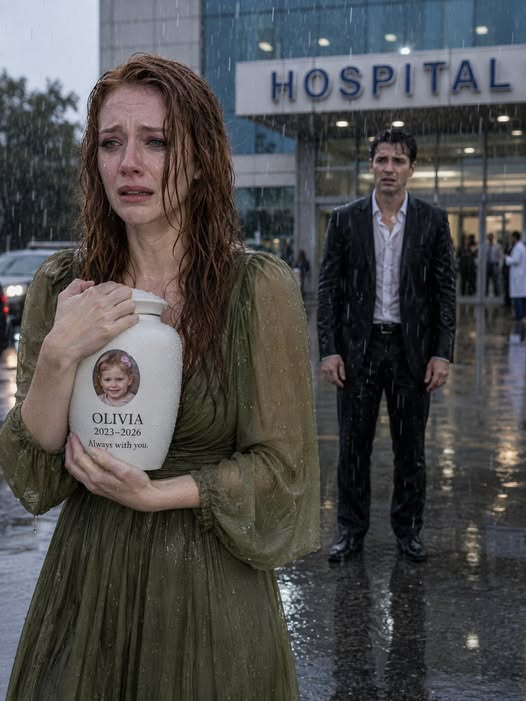
“Stop making a scene and take the girl home, because I have already authorized payment for her treatment,” Mason told me over the phone as I walked out of the hospital with a small white urn clutched tightly against my chest.
For a few seconds I could not even bring myself to answer him. Outside, a bitter rain was falling over San Antonio and the winter air felt entirely freezing. My daughter Daisy had died three days ago at only three years old, having suffered from a severe congenital heart defect that made her weigh so little that holding her felt like holding a tiny wounded bird. Now everything that remained of her life fitted inside this wooden box.
“Okay,” I replied quietly into the receiver.
Mason hung up immediately without noticing anything unusual in my voice. In the background behind his phone line, I could hear soft lounge music, clinking glasses, and the bright laugh of Sabrina, the woman he had been seeing openly at upscale dining spots around San Antonio for the past few months.
I flagged a taxi and headed straight to the Ross family residence in Alamo Heights. I had spent three long years living in that grand house as Mason’s wife, though everyone there treated me like an unwanted intruder.
His sister, Brenda, greeted me right near the front entry hall with an annoyed expression.
“Are you coming from the hospital again?” she asked, rolling her eyes. “Seriously, Elizabeth, this endless obsession of yours has made living in this house completely unbearable for everyone.”
She glanced down at the box in my arms with mild curiosity.
“What did you bring back with you this time?” she inquired.
“Your niece,” I said softly.
Brenda let out a small laugh, assuming I was making a sarcastic joke.
“Don’t be ridiculous,” she sneered.
I looked her directly in the eyes without flinching.
“These are Daisy’s ashes,” I stated plainly.
Her expression froze instantly, and her body went entirely still.
I walked past her and went up the stairs toward the back storage room, where Mason had ordered our daughter’s crib to be moved months ago. He had insisted that the medical equipment, monitors, and crying of a sick child ruined the pleasant atmosphere of the main residence.
For years, whenever I needed to buy specialty infant formula, schedule a doctor appointment, or hire a home nurse, I had to submit formal requisitions through his family’s financial system. Every single expense was reviewed by Megan, Mason’s personal assistant, who unilaterally decided whether a medical request was reasonable or unnecessary.
I had earned a degree in actuarial science and spent years analyzing financial risk before my marriage, yet in this household I was forced to justify even a single package of diapers.
Daisy’s final medical crisis had been terrifyingly swift. Her cardiologist urgently prescribed a high-cost imported medication to stabilize her declining condition, so I immediately submitted the lab results, official prescription, cost estimate, and medical diagnosis to the portal.
Megan rejected the claim within hours, stating, “This expense exceeds your authorized quarterly limit.”
I called Mason seventeen times in a row that afternoon.
He never answered a single call.
Desperate, I drove to his office building and waited in the lobby for five full hours. When he finally walked out of the executive elevator, Sabrina was holding onto his arm.
“Don’t ever embarrass me like this in public again,” he warned me coldly in the lobby. “If you have issues with money, take them up directly with Megan.”
A compassionate hospital doctor ended up paying out of his own pocket for a single dose that kept Daisy stable for a few extra days while I submitted another emergency appeal to the office.
That second request remained marked as under review for an entire week.
On the morning of the seventh day, my tiny daughter stopped breathing.
That night, as I placed the small urn inside her empty crib, I heard Mason coming up the hallway laughing loudly with Sabrina.
“Megan did the right thing by putting a stop to her spending,” he was saying to Sabrina. “Elizabeth thinks she can throw my family’s money around whenever she pleases.”
Hearing that, I pulled an old cell phone from the very bottom of a nightstand drawer, a phone I had not turned on since my wedding day, and dialed a number I remembered by heart.
“Mr. Callahan?” I called out softly.
The elderly man on the line remained silent for a long pause before speaking.
“Miss Elizabeth,” he answered with a deep breath. “I have been waiting for this phone call for three whole years.”
I looked down at my daughter’s urn in the dim light.
“Execute everything my father prepared before he passed,” I instructed him firmly. “Do it completely, without protecting anyone involved.”
At that exact moment, I heard Mason’s heavy footsteps reaching the top of the stairs outside the room. I had no idea what horrifying truth I was about to uncover about my daughter’s final days.
PART 2
Mason pushed the door open abruptly and looked at my face before his eyes landed on the urn.
“What is that thing?” he asked, narrowing his eyes.
“Your daughter,” I replied calmly.
He frowned in deep irritation.
“Stop playing games with me,” he barked.
“Daisy died three days ago,” I said, looking straight at him. “Her medical treatment was suspended because the hospital never received the funds, and I called you seventeen times to save her.”
The color completely drained from his face within seconds.
“Megan told me you were just exaggerating her sickness to get attention,” he stammered.
I pulled a completed divorce petition out of my leather bag and placed it on the small table.
“Well, you can keep believing her if you want,” I said.
He refused to sign the paperwork and tried to physically block the doorway, asking where I thought I could go without a job, an income, or his prestigious family name.
I did not bother to answer him. I simply packed Daisy’s small stuffed bunny, her light blue baby blanket, and the hospital footprint card into a tote bag, then walked out of that mansion holding her urn tightly.
I took a cab to a small one-bedroom apartment in San Antonio that I had leased myself back when I was a college student.
At nine o’clock the next morning, a knock sounded at my front door.
A young professional in a sharp charcoal suit stood in the hallway holding a thick leather folder.
“My name is Caleb,” he said politely. “Mr. Callahan asked me to deliver these original files directly to you.”
The cover of the folder was stamped with the name Vantage Group Holdings.
My late father, Samuel Vance, had been one of the most powerful private venture investors in the country. When I married Mason, I had voluntarily frozen my entire inheritance because Mason despised the thought of me holding an independent fortune, and I desperately wanted to prove that I was marrying him purely for love.
My father passed away two years later, fully aware of Mason’s arrogance and convinced that I would eventually need an escape route.
Caleb opened the folder across from me on the small kitchen table.
“Your legal rights were fully restored early this morning,” Caleb explained. “You now hold absolute voting control over the master trusts, global real estate holdings, and international investment funds that your father set up.”
He then placed a metallic silver drive on top of the documents.
“This contains complete internal records regarding Ross Enterprises,” he added.
I plugged the drive into my laptop immediately.
The folders contained full financial audits, offshore wire transactions, shell companies, and detailed reports on a critical international deal that Mason desperately needed to close in order to save his company from insolvency.
“Who ultimately controls this foreign fund?” I asked.
Caleb looked at me with absolute seriousness.
“You do,” he replied.
For the very first time since Daisy passed away, I felt a sensation that was not pure grief. It was not joy either, but total clarity.
A few days later, I made my official return to the corporate financial sector. My former university mentor, Dr. Warren, invited me to serve as a keynote panelist at a major private equity forum in downtown Houston, where Mason was also scheduled to speak.
When my name was announced as the new Managing Director of Apex Capital, I walked onto the main stage in front of several hundred executives.
Mason was sitting in the front row. He stared up at me as if he were looking at a ghost.
During the afternoon break, he approached me near the grand foyer, his face flushed with anger.
“Who is backing you behind the scenes?” he demanded quietly.
“Nobody,” I answered truthfully.
“That firm appeared out of absolute nowhere,” he spat out.
“It did not appear out of nowhere,” I replied calmly. “You simply never bothered to find out who your wife actually was before you trapped her inside your house.”
His jaw tightened visibly as he stepped closer.
“Do not try to drag my commercial interests into our personal divorce,” he warned.
I offered a slight smile.
“I am not going to touch your business, Mason,” I said softly. “I am simply going to stop protecting it.”
That very afternoon, I issued a formal directive requiring Ross Enterprises to undergo a rigorous, independent financial audit before any capital restructuring could be considered.
Within forty-eight hours, massive financial irregularities began surfacing across their corporate balance sheets.
However, the specific document that genuinely made my blood run cold had nothing to do with their corporate merger. It was buried deep within Daisy’s unpaid medical ledgers from the hospital.
The financial records listed seven separate emergency wire transfers marked as fully approved by Mason Ross.
Yet the pediatric hospital had never received a single cent of that money, and every single transaction had passed directly through Megan’s desk.
What we uncovered next altered the reality of everything I believed had happened.
PART 3
The full investigative audit reached my desk at six o’clock the following morning.
Megan had not simply delayed my emergency requests for Daisy’s care. She had intentionally constructed two entirely separate internal database portals.
On Mason’s executive portal, every single medical charge for Daisy appeared as fully authorized and funded. On my user interface, those exact same requests were displayed as rejected or permanently pending review.
She had systematically redirected those medical funds into offshore accounts controlled by shell entities registered under her family members’ names.
She had done this seven distinct times. Seven transfers meant to pay for a critically ill little girl’s treatments had been stolen to line her own pockets.
I sat staring at the glowing monitor for a long time, completely numb. For weeks, I had repeated to myself that Mason had deliberately denied every single penny to save his own money.
The reality was far more pathetic: he had authorized the expenses, but he had created such a cold and distant home environment that he never bothered to verify if his daughter was actually receiving care. He had delegated his child’s life to a secretary because checking on her was less convenient than ignoring us both.
He was not innocent in her death. He was simply guilty of a different kind of cruelty.
I forwarded the complete forensic evidence package directly to his private email without adding a single comment.
He called my personal number late that night, his voice trembling heavily.
“Did you actually send these bank records?” he asked, breathing heavily over the line.
“Yes,” I answered quietly.
“I swear to you, Elizabeth, I authorized those medical payments,” he gasped.
“I know you did,” I replied.
“So Megan… she stole the money meant for Daisy?” he asked.
I heard a loud crash on his end of the line as if he had smashed something against his office wall.
“I am going to completely destroy her,” he growled.
“No, you are not,” I said firmly. “You are going to let law enforcement do their job, because this is not about your bruised pride, it is about Daisy.”
Three days later, the legal team at Ross Enterprises filed formal criminal charges for grand larceny, wire fraud, and embezzlement.
The police investigation quickly revealed that Megan had been stealing millions from vendor accounts, expense funds, and corporate payroll for over five years. When officers placed her under arrest at the office, she screamed loudly that I had set her up.
Mason did not step forward to offer her any defense, but that did not absolve him of his own choices.
One afternoon, he was waiting outside my apartment building in San Antonio. He had no driver, no luxury watch, and no jacket, looking like a hollow shadow of his former self.
“I went back and checked all my phone logs,” he said softly, handing me a stack of printed records. “All seventeen of your missed calls, your text messages, and the urgent alerts from the hospital.”
He looked down at his shoes with a broken expression.
“I honestly thought Megan was keeping normal home expenses under control,” he whispered. “I genuinely believed you were just exaggerating her symptoms to force me to come home.”
“Because it was far easier for you to label me as hysterical than to look at your sick child,” I said clearly.
He lowered his head and began to weep quietly.
I reminded him of Daisy’s painful final week in the ICU. Her doctor had warned us that without her specialized medication, her heart would fail within forty-eight hours. I had texted him those exact words while he was vacationing in Miami with Sabrina, and he had sent back a single reply: “Deal with Megan directly and stop bothering me with every minor domestic issue.”
Mason collapsed onto a wooden park bench near the sidewalk and covered his face with both hands.
“Please forgive me, Elizabeth,” he sobbed.
“Your asking for forgiveness comes three days after her body was turned to ashes,” I replied steadily.
He begged me for a second chance to rebuild our marriage, but I told him the only meaningful gesture he could offer was to sign the divorce papers immediately.
He resisted signing for several more days, until the cascading financial collapse of his company threatened his entire family’s legacy.
Our comprehensive audit had exposed years of related-party transactions, tax anomalies, and unapproved loans that previous auditors had overlooked due to family connections. I did not fabricate a single charge or manufacture any fake evidence. I simply ordered my team to enforce standard regulatory rules without granting his family special favors.
That was when Charles Ross, Mason’s grandfather and the founding patriarch of the firm, reached out to request a private meeting at his estate in King William.
“What is it that you truly want from us?” the old man asked bluntly across his mahogany desk.
“My signed divorce decree,” I answered without hesitation.
“And what about our business?” he pressed, searching my face.
“If your company operates legally, it will survive,” I said calmly. “If it relies on fraud, it will collapse under the weight of its own decisions.”
He stared at me for a long moment in silence.
“Your father was a remarkably difficult man to deal with,” he noted quietly.
“My father never lost a grandchild because his family found a medical bill inconvenient,” I retorted cold-faced.
The old patriarch slowly lowered his gaze to the desk.
He knew that my father had retained original documentation regarding an old real estate deal that could subject his family to massive legal liability. I had no desire to use those files, but I wanted him to understand that his family could never intimidate me again.
“Mason will sign the papers tomorrow,” Charles finally conceded. “In exchange, you will allow our restructuring plan to proceed if we fix the compliance failures.”
I agreed on one strict condition: within ninety days, Ross Enterprises had to achieve total financial transparency and pass a secondary independent audit.
The very next morning, Mason sent me a brief text message: “My grandfather spoke with me. I am signing today.”
At the law firm later that afternoon, he barely raised his eyes to meet mine.
I signed the legal documents first and pushed the folder across the table to him.
He held the pen suspended over the signature line for several long seconds.
“Do you hate me?” he asked in a hollow voice.
I thought about everything I had endured over those three years. The freezing hospital rooms, Daisy struggling to draw breath, and me begging his assistant for diaper money while he dined out with other women.
“Hating you would require spending energy that you simply do not deserve,” I stated clearly.
He signed his name on the final line.
Before I stood up to leave, he reached into his coat pocket and pulled out a small velvet box.
Inside rested a delicate gold chain featuring a tiny star pendant.
“I bought this the week Daisy was born,” he murmured softly. “I planned to give it to her when she reached one hundred days old.”
“Why didn’t you?” I asked plainly.
He had no answer for me. He simply pushed the box across the table toward my side.
“Take it with you,” he requested.
“No,” I replied, sliding it back toward him. “It was a gift you never had the courage to give her yourself.”
I turned around and walked out into the sunshine. For the first time in three years, I walked down a public street without feeling the need to ask anyone for permission to exist.
I moved into a bright, sunlit apartment in Austin. I placed Daisy’s small urn right next to a wide living room window where the warm afternoon light poured in. When she was alive, Mason had insisted that I keep her indoors so that business associates would not ask uncomfortable questions about her health. Now, no one could ever hide her away again.
Every Sunday morning, I walked down to the local farmers market to buy fresh yellow flowers, placing a tiny bloom beside her box. It was a simple, quiet gesture, but it grounded me in the reality that Daisy had been a real, living child, not just a tragic medical file or a corporate dispute.
I poured my energy into my career.
Vantage Group Holdings thrived under my direct leadership, and Apex Capital established itself as a premier investment firm in the region. I reconnected with former colleagues, launched major venture initiatives, and reclaimed the part of myself I thought had died inside that mansion.
Meanwhile, the state prosecution against Megan moved forward rapidly.
The final forensic report arrived weeks later, confirming that all seven of Daisy’s treatment authorizations had been signed off by Mason before Megan intercepted the funds. One of those transfers matched the exact emergency medication prescribed during Daisy’s final crisis.
When I read that date on the paper, I had to excuse myself from the executive board room.
I walked down to my car in the garage and sat in the dark crying until I could barely breathe.
My tears were not for Megan or Mason.
They were for the lost possibility.
Even if that money had arrived on time, no doctor could guarantee that Daisy would have survived her heart condition, but she would at least have had a fighting chance.
That was what they had taken from me: not a guaranteed future, but a fair opportunity to fight for her life.
Mason received the identical forensic report that same afternoon.
He called my phone late that night, his voice cracked with remorse.
“I could have personally verified those wire payments,” he sobbed into the receiver. “I could have called the hospital directly, or I could have just walked into that room with you.”
I kept silent, listening to his breath.
“I thought being a father just meant writing checks to cover things,” he continued brokenly. “And I did not even manage to do that right.”
“Being a father meant being present,” I told him quietly before ending the call.
Megan was ultimately sentenced to a lengthy prison term and ordered to pay restitution. Many people viewed that outcome as full legal justice, but I felt no sense of victory.
A prison sentence could not replace three stolen years, money could not buy back a single breath, and no court ruling could ever make my little girl call out for her mother again.
The true corporate fallout for Mason materialized months later.
When the ninety-day deadline arrived, Ross Enterprises was required to submit its secondary compliance audit to our board.
They failed to meet the required benchmarks.
While they had corrected basic accounting structures, they stubbornly retained several high-risk offshore practices. Grandfather Charles tried to leverage mutual acquaintances to pressure me into signing off, but Mason surprisingly refused to fight the report.
“If the audit states we failed to comply, then let the decision stand,” Mason told his board of directors.
As a direct result, their primary line of credit was revoked. Their stock price plummeted, forcing Mason to resign as Chief Executive Officer.
Caleb offered to keep me updated on Mason’s personal life, but I declined.
“I do not need any further reports about him,” I said softly.
A month later, a unmarked manila envelope arrived at my office.
Inside was an old photograph of Daisy taken when she was just over three months old. She was lying inside her crib, looking up and smiling, and in the upper corner of the frame, a man’s arm was faintly visible resting on the railing.
On the back of the print, written in Mason’s handwriting, were the words: “Day 103. Today she smiled at me for the very first time.”
An enclosed note read: “Elizabeth, this is the only photograph I have with her. You had gone out to the store that afternoon. I never showed it to you because I was terrified you would realize how deeply I cared about her. I foolishly believed that if I showed emotional attachment, you would gain power over me. I see now how pathetically foolish that was. Keep this photo, because I do not deserve to hold onto it.”
I sat down on my office floor, holding the small photograph in my hands.
For the first time, I came to a realization that hurt me in a quiet way: Mason really had loved his daughter in some buried corner of his heart. But he had mistaken love for vulnerability, and a love that is kept hidden away until someone is gone arrives far too late to save anyone.
I placed the photograph carefully inside my desk drawer. It did not alter my path, nor did it erase his neglect, but it transformed Mason from a villain into something far sadder: a man who possessed the capacity to love his child, yet deliberately chose to act as though he did not.
Months later, my team successfully closed our largest global investment initiative to date. At our celebration dinner, Dr. Warren raised his glass to toast the firm’s success.
“To Elizabeth,” he announced warmly to the room. “A leader who rebuilt her life when everyone assumed she had lost everything.”
I smiled politely at the praise, but my thoughts drifted straight to Daisy.
I had not built this new life alone; every decision I made carried her memory forward with me.
One morning, Caleb casually mentioned that Mason had installed a small stone memorial for Daisy at a quiet cemetery near Alamo Heights, and that he visited the site almost every afternoon.
“Please do not bring me any more updates regarding his life,” I reminded Caleb gently.
That afternoon, I sat down beside the window in my apartment, looking at the white urn.
“It is time for us to go, my love,” I whispered softly to her.
Years ago, I had promised Daisy that once I was strong enough, I would take her to see the ocean along the California coast, the mountain trails in Colorado, and the quiet towns where my father used to take me during summer breaks.
Daisy had never been able to leave her hospital room, but I could still show the world to her now.
I decided to step away from my office duties in Texas for a while. I entrusted the firm’s management to my executive team and packed a single travel suitcase, wrapping Daisy’s urn carefully inside her light blue baby blanket.
On the night before my departure flight, my phone rang, displaying Mason’s number on the screen.
I paused for a moment, then answered it calm and steady.
“I was told you are leaving Texas,” he said quietly.
“Yes, I am,” I replied.
“Where are you going?” he asked softly.
“I have not decided yet,” I answered.
He remained completely quiet on the other end of the line for a long moment.
“Elizabeth… the single worst thing I ever did was make you feel as though you and Daisy were a burden on my life,” he whispered softly. “I know I can never fix what I broke, but I wanted to tell you that you do not ever have to look back. Go live your life far away from all of this pain.”
I looked out my apartment window at the quiet street below, watching a mother guide her child along the sidewalk under the streetlights.
Life was continuing all around us.
“Take care of yourself, Mason,” I said gently.
There was no affection left in my voice, but there was no lingering bitterness either. I realized that this quiet indifference was the ultimate form of personal freedom.
The following morning, I boarded an early flight out of Texas.
Before the cabin doors closed, I opened my phone contacts, scrolled down to his name one last time, and tapped the delete option.
I put the phone away in my bag and held the travel case containing Daisy’s urn close against my lap.
“First we are going to see the mountains,” I whispered softly toward the window. “Then we will go see the ocean, and I am going to show you every beautiful place you never got to see.”
As the airplane accelerated down the runway and lifted into the morning sky, bright sunlight washed through the window and bathed my hands in warmth.
For three long years, I had mistakenly believed that loving someone meant enduring mistreatment, remaining silent through neglect, and waiting endlessly for a person to change.
Daisy had taught me the exact opposite truth.
To love also means having the courage to leave.
It means speaking the truth out loud.
It means refusing to justify those who actively destroy your spirit.
It means understanding that lost wealth can be rebuilt and professional reputations restored, but the precious time we fail to give to those we love can never be recovered.
My true victory did not come from Mason losing his executive position at the firm, nor did it come from Megan going to prison, or even from reclaiming my father’s immense financial empire.
My only real victory was regaining control of my own life before I lost myself completely.
As the city below us faded softly into the cloud cover, I rested my hand over the blue blanket and smiled through quiet tears.
For the very first time since my daughter died, I did not feel as though I was running away from my past.
I felt like I was finally moving forward.
THE END.
