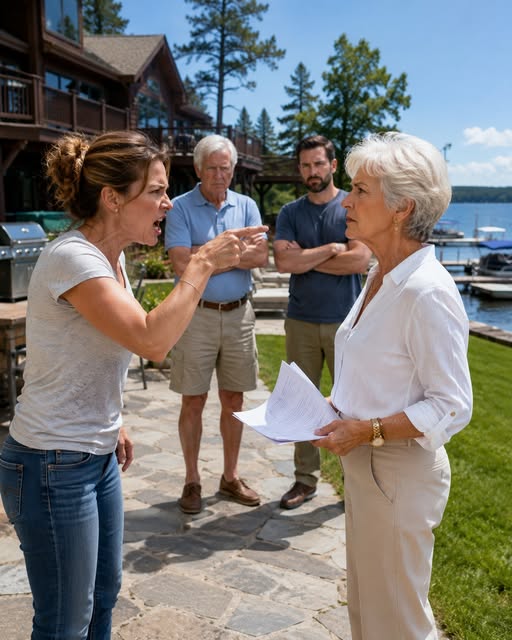
My mother told me I wasn’t welcome at my own lake house after I had spent nearly $70,000 restoring it.
So while she and the rest of my family were still enjoying the place as if it belonged to them, I sold it.
And what happened afterward finally exposed something I had been refusing to see for years.
My name is Natalie Harper, and the house sat on the edge of Lake Chelan in Washington State, surrounded by pine trees, steep hills, and water so blue that my grandfather used to say it could make you forget every bad decision you had ever made.
The house became mine when my grandfather, Walter Harper, died.
Along with the deed, he left me a handwritten note.
It said:
“Make this place your own before somebody else decides what it should mean to you.”
At the time, I thought he was talking about renovations.
It took me years to understand that he meant something much bigger.
The house had been neglected for decades.
The roof leaked badly enough that I had to leave buckets in two upstairs rooms during heavy rain. The back deck had soft spots where the wood had rotted almost completely through. The kitchen looked frozen in another century, with faded green cabinets, yellow countertops, and a refrigerator that rattled every time the compressor started.
But I loved the place.
It smelled like cedar, lake water, and the wood smoke that had soaked into the stone fireplace my grandfather built with his own hands.
I wanted to save it.
So I did.
I refinanced my small condo in Seattle.
I took weekend consulting projects.
I stopped traveling.
I postponed buying a new car.
And over six years, I put about $69,000 into the property.
I replaced the plumbing and most of the electrical system. I installed new windows. I rebuilt the dock after a winter storm damaged half of it. I replaced the roof. I refinished the floors.
The fireplace took nearly a month because I refused to tear it down.
One contractor told me it would be cheaper to replace the whole thing.
I told him no.
“My grandfather built it.”
So we restored it stone by stone.
For a while, the house felt like exactly what my grandfather had wanted me to have.
A place that was mine.
Then my mother, Linda Harper, started calling it “our family lake house.”
The first few times, I didn’t correct her.
It seemed harmless.
She asked if she and my stepfather, Richard Miller, could spend a weekend there.
I said yes.
Then my younger sister, Megan Collins, started coming with her husband and their children.
At first, everyone asked permission.
Then they gradually stopped.
Extra clothes appeared in the closets.
Food I hadn’t bought showed up in the freezer.
Beach towels stayed folded in the linen cabinet.
Richard tied his fishing boat to my dock for an entire summer without asking.
Megan’s kids left toys scattered across the living room.
My mother rearranged the kitchen.
Once, I drove up and discovered she had replaced the curtains because mine were “too dark.”
When I complained, she looked genuinely offended.
“Natalie, it’s just curtains.”
“It’s my house.”
“It’s family.”
That became her answer for everything.
Family.
If I wanted advance notice before someone stayed there, I was being difficult.
If I asked Megan’s children not to jump onto furniture with wet bathing suits, I was being controlling.
If I told Richard not to use my tools without putting them back, I was making everyone uncomfortable.
I kept swallowing it because I didn’t want the house to become a source of conflict.
Ironically, that was exactly how I lost control of it.
The moment everything changed happened over Memorial Day weekend.
I had worked late Friday and didn’t reach Lake Chelan until early evening.
The back of my SUV was filled with groceries, a case of sparkling water, and flowers I had bought for the kitchen table.
Halfway down the road, I heard music.
Then I saw the cars.
There were eight of them packed along my driveway and onto the grass.
For a moment, I actually wondered whether I had forgotten some family event.
Then I saw people standing on the deck.
Someone was grilling.
Megan’s kids were jumping from the dock.
Richard had dragged my new outdoor chairs down beside the firepit.
A group of people I barely recognized were drinking near the water.
I sat in my car for a few seconds, staring.
Nobody had told me.
Nobody had asked.
I got out and walked toward the house.
My mother opened the front door before I reached it.
She was holding a glass of white wine.
Her expression wasn’t happy to see me.
It was surprised.
“Oh,” she said. “You came.”
I looked behind her.
“You knew I was coming.”
She shifted her weight.
“We’re having family time tonight.”
I almost laughed because the sentence made no sense.
“I know. I’m family.”
Her expression tightened.
“Natalie, you always make everything tense when you’re here.”
I stared at her.
“What does that mean?”
She lowered her voice.
“It means everyone is relaxing. Megan brought friends. Richard invited a couple from the marina. You’re going to start worrying about furniture and rules.”
I felt heat rise behind my eyes.
“This is my house.”
She looked at me for a long moment.
Then she said:
“I’m telling you that tonight, you’re not really welcome.”
Behind her, somebody laughed loudly.
Music continued playing.
A screen door banged in the wind.
And suddenly, everything became very quiet inside me.
I had paid the taxes.
I had paid the insurance.
I had paid every contractor.
My name—and only my name—was on the deed.
I had spent six years sacrificing weekends, vacations, and savings to repair a place my grandfather had specifically left to me.
And my own mother was standing in my doorway, telling me that I had become an inconvenience in my own home.
I didn’t argue.
I didn’t yell.
I smiled.
“Okay.”
She looked relieved.
That should have hurt more than it did.
But by then, something in me had already shifted.
I walked back to my SUV and drove to Seattle.
I stopped once at a gas station because my hands were shaking so badly I couldn’t hold the steering wheel properly.
By the time I reached my condo, the shaking was gone.
I opened my laptop.
For several months, a real estate agent named Rachel Morgan had been contacting me on behalf of a buyer who loved the property and had offered to purchase it more than once.
I had always refused.
That night, at 11:42 p.m., I emailed her.
I wrote:
“If your buyer is still interested, I’m ready.”
Rachel called me the next morning.
“Natalie, are you serious?”
“Yes.”
“The buyer wants a fast closing.”
“How fast?”
“He could take possession almost immediately.”
“Good.”
She paused.
“Is anyone staying there?”
I opened the family group chat.
Mom had posted a photo from my deck.
The caption read:
Our favorite family paradise.
I stared at it.
“Yes,” I said. “But not for long.”
Rachel explained that because my relatives had never paid rent, signed leases, or legally established tenancy, the situation was straightforward, but she still advised me to provide written notice revoking their permission to remain.
So I did.
Every adult staying there received the same message.
The property was under contract.
Their permission to stay had been withdrawn.
All personal belongings had to be removed by Tuesday at noon.
My mother called less than five minutes later.
“What is this nonsense?”
“It’s notice that I’m selling the house.”
She laughed.
“No, you’re not.”
“Yes, I am.”
“You can’t sell Grandpa’s house.”
“He left it to me.”
“He meant for everyone to enjoy it.”
“Then maybe everyone should have remembered whose house it was before telling me I wasn’t welcome.”
Her voice changed.
“You’re doing this to punish us.”
“No. I’m doing this because I finally understand the arrangement you wanted. You wanted me to pay for a family property that everyone else controlled.”
Richard took the phone.
“Natalie, slow down. Don’t make a permanent decision because you’re emotional.”
“The decision is already made.”
By Monday, Megan had sent me a stream of messages.
She talked about childhood memories.
Her children’s summers.
Our grandfather.
Family loyalty.
She said selling the property because of “one bad weekend” was cruel.
Not once did she mention the money I had spent restoring it.
Not once did she mention the fact that our mother had told me to leave.
Tuesday morning, Rachel called.
Her voice sounded different.
“We have a problem.”
My stomach tightened.
“What happened?”
“Your mother contacted the title company. She claims she has partial ownership.”
I almost laughed.
“She doesn’t.”
“She submitted documentation.”
Rachel emailed me a copy.
The document claimed that my grandfather had promised Linda an ownership interest in the property.
At the bottom was his signature.
At first, it looked real.
Then I saw the date.
October 9, 2019.
I stopped breathing.
I remembered that date perfectly.
I had spent that entire day sitting beside Grandpa at a hospital in Tacoma after a stroke.
His right side was partially paralyzed.
He couldn’t sign his own discharge paperwork.
He couldn’t even lift a spoon properly.
Yet the signature on my mother’s document was smooth.
Strong.
Perfect.
My anger disappeared.
Fear replaced it.
This was no longer a family fight.
I called the attorney who had handled my grandfather’s estate, Samuel Price.
He asked me to forward everything.
Two hours later, he called back.
“Natalie,” he said, “that document is fraudulent.”
He explained that the parcel number printed on it hadn’t even been created until 2021.
The document was supposedly signed in 2019.
Then he compared the signature with medical and estate records from the same period.
Someone had copied Grandpa’s signature from another document.
The sale had to be temporarily delayed while the title company investigated the false claim.
That afternoon, I drove back to the lake house with Rachel, Samuel, and a county sheriff’s deputy who agreed to stand by while formal notice was delivered.
Mom was on the deck when we arrived.
The second she saw the deputy, her face changed.
Richard came outside behind her.
Megan stood in the doorway holding her phone.
Mom stared at me.
“You brought law enforcement to your own family?”
I held up the disputed document.
“You submitted a fake ownership claim during the sale of my property.”
Richard turned slowly toward her.
“Linda?”
She didn’t answer him.
Instead, she looked at me.
“Your grandfather wanted me to have part of this house.”
“Then why did you need to fake his signature?”
Silence.
The lake behind us was almost perfectly still.
Finally, Mom admitted it.
She had found an old letter Grandpa had signed.
She copied the signature.
She created the document because she wanted to delay the sale until I “calmed down.”
“I wasn’t stealing anything,” she said. “I was protecting the family.”
Samuel spoke before I could.
“You filed a false ownership document. That isn’t protecting the family.”
Richard picked up his suitcase.
“I didn’t know about this.”
Mom stared at him in disbelief.
Megan began crying.
For the first time, I think she understood that this was no longer about me being stubborn or dramatic.
Our mother had crossed a line.
They packed until sunset.
I stood on the dock while they carried bags, coolers, toys, and clothes out of the house.
Nobody yelled anymore.
Twelve days later, the sale closed.
The buyer was a widowed civil engineer named James Holloway.
He planned to retire there with his elderly black Labrador.
He bought most of the furniture too.
During the final walkthrough, he noticed the framed photograph of my grandfather standing on the dock with a fishing rod.
“Would you mind if I kept this?” he asked.
I looked at it.
For a second, I thought leaving it there might feel right.
So I said yes.
James picked up the frame.
Then he looked at me.
“No.”
I frowned.
He handed it back.
“This belongs with you.”
That was when I finally cried.
Not because I regretted selling.
Because I understood what had happened.
Grandpa had given me a home.
Over time, my family had turned it into a place where I needed their approval to exist.
After paying off the renovation debt, closing expenses, and what remained on my condo refinance, I had enough money left for a down payment on a small cabin farther north.
It has one bedroom.
A crooked porch.
A wood stove.
And absolutely no space for eight surprise cars.
I love it.
Mom and I didn’t speak for almost eight months.
Then one afternoon, a handwritten letter arrived.
She admitted she had spent years telling herself that because she was Grandpa’s daughter, she somehow deserved whatever he left me.
She apologized for the forged document.
She apologized for making my work and money feel like something the whole family automatically owned.
And finally, she apologized for telling me I wasn’t welcome.
I didn’t forgive her immediately.
Because forgiveness and access are not the same thing.
You can stop hating someone without giving them another key.
Megan and I repaired our relationship sooner.
She paid for damage her children had caused to part of the dock.
One evening, she called and said:
“I think Mom convinced all of us that your boundaries were selfish because it made things easier for us.”
That was probably the most honest thing anyone had said about the situation.
A year after the sale, an envelope arrived from James.
Inside was a photograph.
He was sitting on the rebuilt dock with his Labrador beside him.
The lake stretched behind them under a pale morning sky.
On the back, he had written:
“Your grandfather built something beautiful here. Thank you for trusting me with it.”
I keep that photograph in my cabin.
Right beside Grandpa’s fishing picture.
Because selling the lake house was never really about revenge.
My mother told me I wasn’t welcome in a house that legally, financially, and emotionally belonged to me.
For years, I had tried to keep everyone happy because I thought family meant making room.
But I had forgotten something.
Making room for people does not require disappearing from your own life.
So I stopped begging to belong in the place my grandfather had already given me.
I sold the house.
I bought something smaller.
Quieter.
Mine.
And for the first time in years, when I unlock the door, nobody else gets to decide whether I’m welcome inside.
