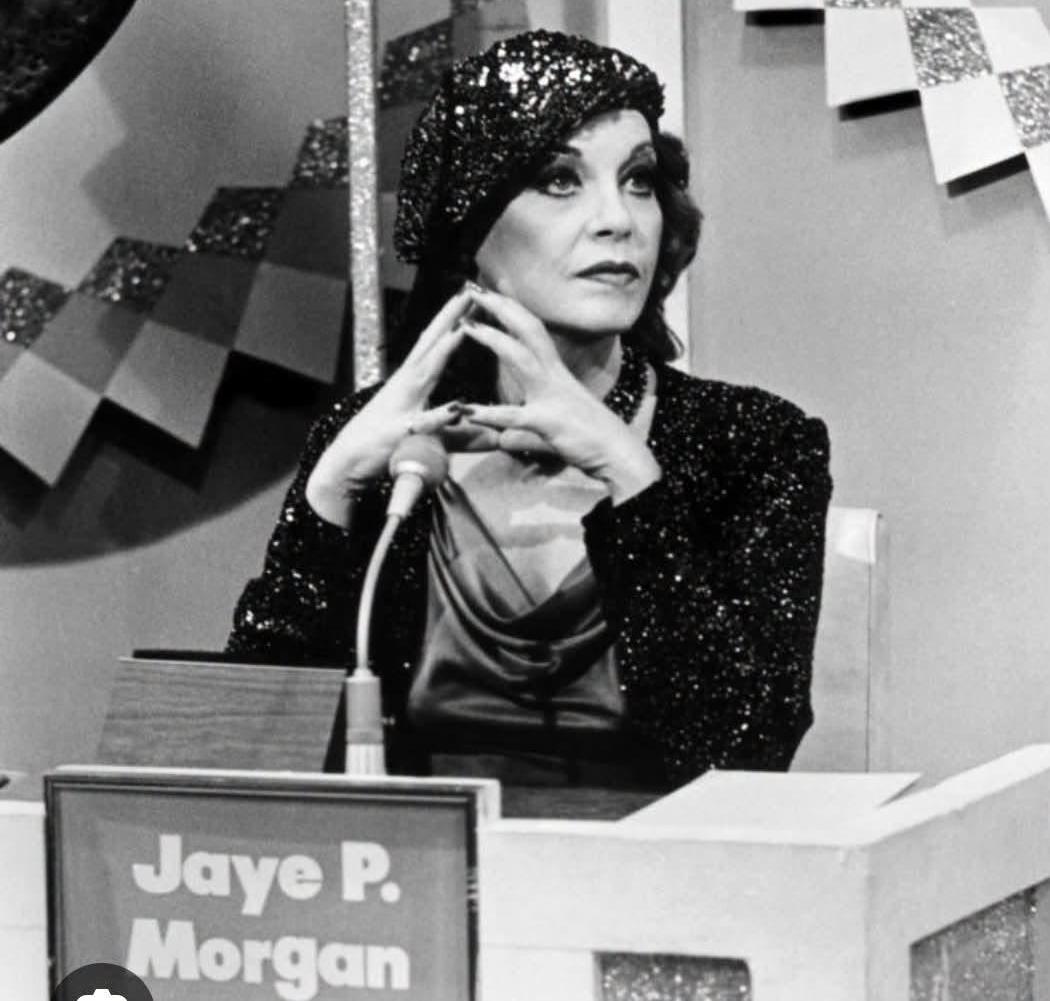
Jaye P. Morgan, the versatile American entertainer who achieved success as a recording artist before becoming one of television’s most recognizable and unpredictable personalities, has died at the age of 94.
Morgan died of natural causes on Monday, August 24, 2026, in Longview, Washington, according to her longtime attorney and friend, Mark Sendroff. She had reportedly been living with her nephew and niece, Duke Morgan Spencer and Peggy Sue Spencer.
Throughout a career spanning music, television, nightclubs and film, Morgan continually reinvented herself. She first became famous as one of the leading female recording artists of the 1950s. A new generation later discovered her through her lively appearances as a celebrity judge on the unconventional television talent competition The Gong Show.
Her confident personality, quick humor and willingness to be spontaneous helped make her an unforgettable figure in American entertainment.
From a Family Vaudeville Act to National Fame
Jaye P. Morgan was born Mary Margaret Morgan on December 3, 1931, in Mancos, Colorado. Her introduction to show business came remarkably early. At only three years old, she began performing as part of the Morgan Family, a traveling vaudeville act that included her parents, her sister and five brothers.
The family performed together until the death of Morgan’s father in 1945. Although that chapter of her young life ended, her interest in entertaining audiences continued.
While attending high school in California, Morgan served as class treasurer. Her classmates reportedly nicknamed her “J.P.” after the famous financier J.P. Morgan. She eventually changed the spelling to “Jaye P.” and adopted it as her professional name.
By the age of 17, Morgan was singing professionally again. In 1950, she joined the orchestra of composer and bandleader Frank De Vol, performing with the group for approximately three years. The experience helped introduce her voice to a wider audience and prepared her for a successful solo recording career.
A Leading Voice of the 1950s
Morgan’s career flourished during the 1950s, when she became one of the decade’s most successful female vocalists. Her clear, expressive voice and charismatic performance style appealed to audiences during a rapidly changing period in popular music.
Her biggest recordings included “That’s All I Want From You” and “The Longest Walk,” both of which reached the Top 10. She also found success with songs such as “Danger! Heartbreak Ahead,” “If You Don’t Want My Love” and “Pepper-Hot Baby.”
The year 1955 was especially successful for Morgan, who reportedly had five hit recordings during that year alone.
She also recorded popular collaborations with other major singers. Her work with Perry Como included “Chee Chee-Oo Chee (Sang the Little Bird)” and “Two Lost Souls.” She additionally recorded “Mutual Admiration Society” with country music legend Eddy Arnold.
Morgan’s achievements were not limited to the recording studio. She became a popular nightclub performer and made her Las Vegas debut at the New Frontier Hotel and Casino. Her performances demonstrated that she was more than a recording voice—she was a confident entertainer capable of commanding a live audience.
In 1954, DownBeat magazine’s annual disc jockey poll named her the best new female singer of the year, further establishing her position in the entertainment industry.
Becoming a Familiar Television Personality
As Morgan’s music career grew, television provided her with another platform. She appeared regularly on programs including the daytime variety show hosted by Robert Q. Lewis and the game show Stop the Music.
In 1956, she was given her own NBC variety program, The Jaye P. Morgan Show. Having a television show bearing her name was a significant achievement and reflected the level of fame she had reached.
Morgan later became a frequent guest on some of the most popular talk and variety programs of the era. Her appearances included The Tonight Show Starring Johnny Carson, The Merv Griffin Show and The Mike Douglas Show.
Audiences came to appreciate not only her singing ability but also her candid humor and unpredictable personality. She was comfortable speaking without a script and was rarely afraid to say exactly what she thought. Those qualities eventually helped her begin a memorable new phase of her career.
An Unforgettable Judge on ‘The Gong Show’
Morgan became widely known to television audiences in the 1970s as a regular celebrity judge on The Gong Show. Hosted by Chuck Barris, the unusual talent competition featured amateur performers presenting acts before a panel of three celebrity judges.
If a performance became unbearable, a judge could strike a large gong and bring the act to an immediate end. The show became famous for its eccentric contestants, playful atmosphere and intentionally chaotic humor.
Morgan was a natural fit for the program. Her reactions were expressive, her comments were spontaneous and her sense of humor matched the show’s unpredictable energy. She did not behave like a distant celebrity evaluating contestants. Instead, she became an active part of the entertainment.
Her favorite act was reportedly Count Banjula, a performer who played the banjo while hanging upside down.
Morgan’s time on the program also included one of the most controversial moments in the show’s history. During a performance by stagehand Eugene Patton, better known to viewers as “Gene Gene the Dancing Machine,” Morgan opened her shirt and briefly exposed herself to the camera. NBC subsequently barred her from the program.
The moment added to Morgan’s reputation as one of television’s most fearless and unpredictable personalities. Footage from the incident later appeared in The Gong Show Movie.
Despite the controversy, Morgan spoke positively about her experience on the show. She enjoyed the work, the exposure and the opportunity to entertain audiences in a very different way from her earlier singing career.
Acting and Later Appearances
Morgan’s talents also extended to acting. She appeared in several films and television productions, often bringing the same energetic personality that made her successful as a singer and game-show panelist.
Her screen appearances included The Muppet Show, Home Alone 2: Lost in New York and Confessions of a Dangerous Mind, the 2002 film based on the life of The Gong Show creator Chuck Barris.
Morgan also appeared on programs such as Match Game, Hollywood Squares, Rhyme and Reason and Make Me Laugh. Her ability to move between music, comedy, acting and unscripted television made her an unusually versatile performer.
Even when musical tastes changed and the popular culture of the 1950s gave way to new styles, Morgan found ways to remain relevant. Rather than being remembered only for her early recordings, she successfully created a second public identity as a humorous and uninhibited television personality.
Remembering a One-of-a-Kind Entertainer
Jaye P. Morgan’s career reflected several distinct periods of American entertainment history. She began in the fading tradition of traveling family vaudeville, rose to national fame during the golden age of popular vocal music and then embraced the increasingly informal and unpredictable world of television.
For music fans, she will be remembered as the voice behind recordings such as “That’s All I Want From You” and “The Longest Walk.” For television viewers, she will remain the outspoken and entertaining judge who helped make The Gong Show a cultural phenomenon.
Morgan possessed the rare ability to be both a serious singer and a playful television personality. She could deliver a heartfelt song before an elegant nightclub audience and later laugh alongside some of the strangest performers ever seen on American television.
Her boldness occasionally created controversy, but it also made her authentic. She refused to disappear into the background or behave according to someone else’s expectations. Whenever Jaye P. Morgan appeared onstage or onscreen, audiences knew that something memorable could happen.
Morgan is survived by her son, Paul Kane, as well as members of her extended family.
Her death brings an end to the remarkable life of a performer who entertained audiences for decades. From her childhood appearances with the Morgan Family to her chart-topping recordings and unforgettable television moments, Jaye P. Morgan left a distinctive mark on American popular culture.
She was 94.
