My father threw my grandmother’s savings passbook directly into her open grave and called it completely worthless. The very next morning, I walked straight into the bank, and the young teller turned as pale as a ghost before frantically calling the police.
“That stupid book isn’t worth a single dime, so just let it rot down there with the old lady,” my father spat out with complete disdain.
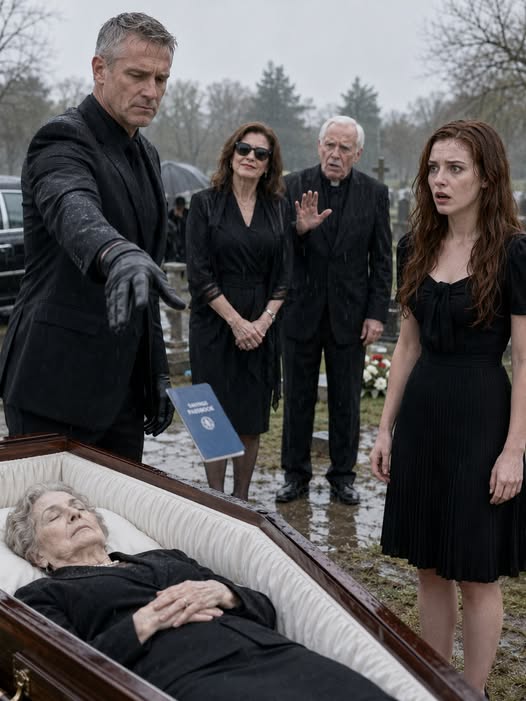
My father, Gregory, tossed the small blue passbook onto Grandmother Beatrice’s casket without a second thought. It landed right on her chest among the heavy clumps of wet mud and wilted funeral lilies. Nobody moved a single inch to stop him, not my uncles, not my cousins, and not even Pastor Samuel who had just finished the final prayer at Cedar Ridge Cemetery.
Two nights earlier, Beatrice had squeezed my hand tight in the dimly lit room and whispered, “Samantha, please make sure Gregory never finds it.”
Gregory was my father, and he was the absolute last person on earth she trusted.
I was twenty-seven years old, standing in the cold grass wearing a borrowed black dress while my cheap flats sank deep into the damp ground. Dad adjusted his black leather gloves and gave me a bitter smirk that made my skin crawl. He always wore that exact look whenever he dismissed my tears as pure drama, whenever he stole my college scholarship money, or whenever Grandma stepped between us to make sure he didn’t lay a hand on me.
“There is your whole inheritance, Samantha,” he said, pointing a gloved finger down into the muddy pit. “An old useless notebook with no house, no land, and no money attached to it.”
Pamela, my stepmother, let out a nasty little laugh from behind her dark designer sunglasses. My half-brother, Dustin, leaned toward me with a sneer and said, “If there’s fifty bucks in that blue book, you are buying us all burgers tonight.”
A few of my cousins laughed at his joke, but I stood completely silent.
Grandma always kept that specific passbook wrapped inside an embroidered cloth napkin inside a rusted butter-cookie tin under her bed. Once every month, she would carry it to the local bank along with her favorite knit cardigan and her old clasp purse. When I was a little girl, I often saw her sitting quietly beside the porcelain angel on her kitchen table with that book open.
“This little piece of paper is for when I am gone,” she used to whisper softly while running her fingers over my hair. “Only you are supposed to know about this, sweetie.”
When the cemetery workers lowered her casket into the ground, Dad did not shed a single tear for his mother. He stood there watching the heavy dirt fall as if he were making sure a dangerous secret stayed buried forever. As soon as the service ended, my family turned around and started walking toward their cars without looking back.
I stayed behind in the quiet graveyard.
I listened to the sound of their shoes crunching across the gravel path, the slamming of heavy car doors, and the loud roar of engines pulling away into the distance.
Once the cemetery was completely empty, I dropped to my knees in the cold grass and dug into the wet dirt with my bare hands until my fingernails scraped against the soft cover of the passbook. I pulled it free, wiped the thick brown mud across my black dress, and opened the very first page to read her handwriting.
Beneath the name Beatrice Vance, Grandma had written one shaky sentence in dark blue ink.
“If Gregory tells you this is worth nothing, it is only because he already tried to cash it himself.”
I stood up and ran as fast as my legs could carry me.
That night, I locked myself inside my small apartment near the Riverfront Market, shoved a heavy wooden chair under the door handle, and opened the blue passbook under the harsh yellow light of my desk lamp. The earliest entries in the book looked completely ordinary, showing simple deposits of fifty dollars, a hundred and twenty dollars, three hundred dollars, or occasionally a thousand dollars. These were small savings accumulated over many long years of baking pies, doing laundry, and hemming clothes for neighbors.
Then the entries suddenly changed.
There were massive withdrawals, rapid transfers, and enormous amounts of money that Grandma never should have had available to move around on her own. Written right beside every single one of those suspicious transactions were the exact same initials over and over again.
G.V.
Gregory Vance.
My father.
A tightly folded sheet of paper was wedged deep between two middle pages, covered entirely in Grandma’s familiar handwriting.
“Samantha, if you are reading this paper right now, please forgive me for not telling you the whole truth much sooner. Your father did not just take money from my personal savings, but he also tried to steal something that has been rightfully yours since the day you were born.”
At the bottom of the page, she had added a crucial instruction.
“Do not go to the rest of the family for help, do not trust a single word Pamela says, and go straight to the bank to ask for the account marked with the red stamp.”
I carefully searched through every single page until I finally found what she meant on the very last sheet, where a faded red circular stamp sat right next to a handwritten bank routing code.
I did not sleep for a single minute that night.
At eight o’clock the very next morning, wearing the exact same mud-stained black dress from the funeral, I walked into the main branch of First Horizon Bank on Grand Avenue. I kept the blue passbook hidden deep inside a brown paper grocery bag wrapped in a clean hand towel. All around me, ordinary customers were complaining about their debit cards, cashing tiny checks, or trying to quiet their noisy kids while everything seemed completely normal to the rest of the world.
My life was anything but normal.
A young bank teller named Lauren looked up at me with a polite, practiced smile and said, “Good morning, welcome to First Horizon Bank, how can I help you today?”
I unwrapped the towel and placed the mud-covered book on her counter. “This belonged to my grandmother who passed away yesterday, and she specifically asked me to bring it directly to this branch.”
The teller typed the account number into her computer.
She frowned at the screen.
She entered the numbers a second time to make sure she hadn’t made a typo.
She stared intensely at her computer monitor, then looked down at the muddy passbook, and finally raised her eyes to look directly into my face.
Every single bit of warm color instantly drained from her cheeks until she looked entirely pale.
“Are you a direct relative of the primary account holder?” she asked, her voice trembling slightly.
“Yes, I am her granddaughter, Samantha Vance.”
“May I please see your driver’s license right now?”
I slid my state identification card across the smooth marble counter, watching as her hands began to shake violently while comparing my photo to the information on her screen.
Without saying another word to me, she picked up her desk phone with a quick, nervous motion.
“Mr. Miller, I need you to come to window four immediately,” she whispered frantically into the receiver. “And please alert bank security right now.”
Before I could even ask her what was happening, she dialed another short number and made the urgent police call promised by whatever terrifying warning had just popped up on her screen.
A tall man in a sharp gray suit hurried over from the back offices with his name tag sitting crooked against his jacket lapel. He immediately flipped the Window Closed sign, reached past the shaking teller, and picked up the muddy blue passbook with both hands.
PART 2
The manager opened the passbook directly to the back page where Grandma had carefully stamped the faded red circle. He studied the handwritten routing code for a long moment before looking back up at my driver’s license.
He checked my photo once.
He checked my photo twice.
His sharp jaw tightened visibly as he processed the information.
“Ms. Vance, I am going to need you to come with me and stay inside the bank for a little while,” he said in a very firm, quiet tone.
“Can you please tell me what is going on here?” I asked, my heart hammering against my ribs.
He offered no answer at all.
The young teller was still standing right behind him, staring at her computer screen as though she had uncovered a dangerous secret that wasn’t meant for human eyes. I could hear other customers casually chatting at the far end of the counter, but window four felt completely sealed off from the rest of the world.
The manager verified Grandma’s full legal name on his clipboard, reading aloud, “Beatrice Vance.” Then he looked directly at me and read, “Samantha Vance.” His eyes darted right back to the red stamp on the last page of the passbook.
Behind his back, the teller swallowed hard and whispered, “It is really her, Mr. Miller. That is the girl from the old case file.”
My stomach dropped into a cold pit because I had never heard of any case file in my entire life. Grandma had never mentioned a single word about legal trouble, and my father certainly hadn’t dropped any hints about official police records.
The manager took two steps backward away from the teller window, clutching Grandma’s muddy blue passbook against his chest as if it were fragile evidence.
PART 3
Mr. Miller held that little book tightly between both hands, looking as if he were suddenly terrified that dropping it might break a crucial chain of evidence.
For the very first time since I had stepped into the building, nobody was asking me to explain why I was standing there in a filthy funeral dress.
The bank staff were looking at me as though they already knew the most terrifying part of the story, leaving me as the only person in the room who was completely in the dark.
The teller reached beneath her counter and pressed a hidden silent button while keeping her eyes fixed on me.
The manager glanced nervously toward the front double doors, then gestured for me to follow him through a heavy wood-paneled side door.
“Ms. Vance, please bring all of your personal identification with you right now,” he instructed politely.
“Should I grab my grandmother’s passbook as well?” I asked, reaching toward the counter.
He pulled it slightly out of my reach and said, “No, I will be holding onto this official record myself.”
That direct answer scared me far more than if he had simply told me to keep it in my bag.
I followed him down a narrow carpeted hallway into a small private office located directly behind the main teller line, still wearing the exact same black dress I had worn during Grandma’s burial service.
Thick patches of dried cemetery mud had hardened all along the bottom hem of my skirt.
There was dark earth deeply embedded underneath my fingernails from digging through the soil above her coffin just hours before.
I noticed every single one of those tiny details because focusing on small physical sensations kept me from completely losing my mind over the teller’s strange words.
The girl from the case file.
I sat down in a cold vinyl visitor’s chair while Mr. Miller remained standing near the desk.
He carefully set the muddy passbook in the middle of his blotter but kept his left hand resting right next to it.
A few seconds later, the teller walked into the room carrying a freshly printed paper held flat against her chest to hide the text.
“What case file were you talking about out there?” I asked directly, looking between the two of them.
Neither of them answered my question right away.
Instead, Mr. Miller pulled his rolling chair out from behind the massive oak desk and sat down right in front of me.
That simple movement instantly changed the entire dynamic of the room.
He was no longer treating me like a regular customer who needed help with a routine deposit.
He was speaking to me like a key victim in an ongoing criminal investigation.
“Before I can explain the details that I am permitted to share, I need to confirm a few identity markers with you,” he said calmly.
He asked for my full legal name.
He asked for my exact date of birth.
He asked for my current home address.
Then he looked me dead in the eye and asked whether Beatrice Vance was my biological grandmother.
“Yes, she was my mother’s mother,” I answered immediately.
“And Gregory Vance is your biological father?”
“Yes, he is.”
The teller’s eyes instantly dropped down to the printed sheet resting in her hands.
Mr. Miller noticed her reaction, and I certainly did not miss it either.
“Please just tell me what is going on,” I demanded, leaning forward in my chair.
He folded his hands over his knees and took a deep breath.
“Several years ago, our fraud prevention department placed a severe legal restriction on a high-value account tied directly to your social security number.”
I stared at him in complete disbelief.
“You must have the wrong person because I don’t have any account at this bank.”
“Ms. Vance, you most certainly do.”
Those five simple words made my entire body go completely numb.
I felt the hard vinyl seat beneath me, the scratchy fabric of my dirty funeral dress against my skin, and the dried soil pulling tightly at my knuckles.
Right then, Grandma’s soft voice echoed clearly inside my head again.
He also tried to take something that has been rightfully yours since the day you were born.
“What kind of account is it?” I asked, my voice barely above a whisper.
Mr. Miller picked up the passbook, turned it around so it faced me, and flipped directly to the page with the faded red circle.
“This specific routing stamp connects directly to a restricted trust savings account that was legally established in your name when you were just an infant.”
My mouth went completely dry as I tried to process his words.
“Was it set up by my grandmother?”
“Beatrice Vance was formally named as the sole trustee authorized to safeguard those funds throughout your childhood,” he explained clearly.
“And my father Gregory?”
He paused for a long second before answering. “Gregory Vance was explicitly excluded from having any access or authority over that trust.”
The entire room seemed to shrink around his words as the reality hit me.
I immediately thought about every single birthday growing up when Dad had angrily complained that Grandma was completely spoiling me with gifts.
I thought about every secret moment when she had slipped a fresh twenty-dollar bill into my palm and quietly warned me never to mention it to my father.
I remembered every screaming match where he had accused her of manipulating me and trying to turn his own daughter against him.
For my entire life, I had genuinely believed those bitter fights were just about her hating his harsh personality.
Now I realized the terrifying truth beneath those arguments.
Mr. Miller went on to explain that the underlying account had remained largely untouched throughout my early childhood years.
Over time, Grandma had regularly made small personal deposits into that fund whenever she could spare extra money.
None of those small deposits surprised me at all, but my jaw dropped when he revealed the exact reason why the severe security restriction had been placed on it in the first place.
Someone had repeatedly attempted to gain full control of the substantial trust after I turned eighteen years old.
The teller stepped forward and placed her printed document on the desk between us.
I could not read the fine print from where I was sitting, but I could clearly see a long list of dates running down the left column.
Mr. Miller tapped his finger against the very first entry on the timeline.
“There was an official request submitted to change the legal mailing address on file.”
He tapped a second date further down the page.
“Then there was a fraudulent application submitted to add a second authorized signer to the balance.”
He tapped a third date.
“And then came multiple aggressive attempts to execute cash withdrawals.”
I already knew the exact answer before the question even left my lips. “Was it Gregory who tried to take the money?”
Mr. Miller did not verbally confirm the name.
He didn’t need to say a single word.
He simply turned Grandma’s passbook around and pointed his pen at the identical bold initials I had spent all night analyzing under my desk lamp.
G.V.
My father’s initials.
However, the most shocking revelation was still to come.
Those massive withdrawal entries in the passbook, which I had assumed were money being stolen directly from Grandma’s life savings, were actually something entirely different.
Some of those large figures were personal transfers that Grandma had deliberately pulled from her own life savings after discovering that money from my trust had been illegally moved without her consent.
She had spent years quietly replacing every single dollar that my father had managed to siphon away.
She did it fifty dollars at a time at first.
Then she deposited hundreds of dollars whenever she saved enough.
Then she made massive lump-sum transfers whenever she managed to sell her handcrafted goods.
Her pie baking money.
Her laundry service money.
Her custom alteration money.
The exact same ordinary little cash deposits I had watched her make when I was a little girl sitting beside her kitchen table had actually been part of a desperate rescue mission.
Grandma hadn’t been quietly accumulating a personal fortune for her retirement.
She had been spending her golden years quietly repairing the financial damage caused by her own son.
“She was paying back what he stole from me?” I whispered, tears welling up in my eyes.
Mr. Miller gave me a solemn nod. “Based on our internal audit records, Beatrice was actively restoring every cent she believed belonged to you.”
I pressed my hands tightly together in my lap to stop them from shaking.
For as long as I could remember, my father had always painted Grandma as a controlling, paranoid, and miserable old woman.
He constantly told the family that she kept absurdly detailed financial records because she was completely insane and trusted no one.
The tragic reality was that she had finally learned she couldn’t trust her own son.
Mr. Miller turned to another yellowed page in the back of the book where Grandma’s handwriting had noticeably changed.
Her soft, flowing loops had turned into sharp, heavy strokes pressed deep into the paper.
Written directly beside a major transfer was a short, determined phrase.
For Samantha. Must replace everything.
I had to look away from the page because my heart was breaking into a million pieces.
It was not because of the money itself.
It was because I suddenly understood how many lonely years she had spent fighting a desperate battle against her son without ever letting me know the burden she was carrying.
A sharp knock sounded against the frosted glass of the office door.
Mr. Miller immediately stood up from his chair.
Two uniform police officers from the local department were standing in the hallway alongside a bank security guard.
My immediate instinct was to leap out of my chair in a panic.
Mr. Miller gently raised his hand to calm me down and said, “Please do not worry, Ms. Vance, you are not in any kind of legal trouble today.”
His reassurance helped a little bit, but the tension in the room remained suffocating.
The taller officer stepped inside and asked if I was willing to answer some formal questions regarding how I had come into possession of the muddy passbook.
I sat right back down and told them every single detail without holding anything back.
I told them about Grandma’s desperate warning in the hospital two nights before she died.
I described my father throwing the passbook onto her coffin at Cedar Ridge Cemetery.
I repeated his cruel words about letting the book rot in the dirt with the old lady.
I told them how the entire family had driven away and left me standing alone in the rain.
I explained how I had dropped to my knees and dug through the fresh mud with my bare hands to retrieve it.
I showed them the handwritten note tucked between the pages and pointed out the red stamp on the back page.
When I finally finished speaking, the younger police officer looked down at the dark soil still packed tightly under my nails.
“You personally dug this passbook out of her grave earlier today?” he asked to confirm.
“Yes, right after the funeral service ended and everyone else left,” I replied firmly.
“And your biological father deliberately threw it into the open grave in front of witnesses?”
“He tossed it right onto her chest while everyone was watching.”
The officer carefully noted every word in his small notepad.
That detail was crucial.
My father had spent my entire life making sure his worst actions happened behind closed doors where nobody else could see them.
This time, his arrogance had completely ruined him.
My uncles had seen him do it.
My cousins had watched from the front row.
Pamela had stood right beside him.
Dustin had made jokes about it.
Even Pastor Samuel had been standing right there at the edge of the grave.
For the first time in his life, Gregory Vance had created an entire crowd of eyewitnesses to his own crime.
The senior officer asked to inspect the folded letter Grandma had left inside the book.
I pulled the original paper out of my grocery bag and handed it over to him with trembling fingers.
He read through the lines with a serious expression, pausing when his eyes reached the sentence detailing how Dad had tried to steal my birthright.
He looked over at Mr. Miller and asked, “Does this handwritten statement align with the documentation in your bank fraud file?”
Mr. Miller answered carefully. “It is entirely consistent with the evidence that prompted us to lock the trust account.”
That was the exact moment I finally understood why the young teller had turned pale when she first typed in the numbers.
The bank staff had not called the police because a messy girl had walked in with an old savings book.
They had called the police because a key figure in an active fraud file had just passed away, the named beneficiary had suddenly appeared at window four, and the crucial physical paper record everyone had been trying to locate for years was sitting right there on their counter covered in fresh grave dirt.
Grandma had never intended for me to just go collect a pile of cash.
She had sent me to that bank to finally complete the evidence chain and bring her son to justice.
Mr. Miller took a deep breath and asked if I wanted to know the current total balance of the account.
For a strange second, I almost wanted to tell him no.
My father’s loud voice was still echoing inside my head, mocking me with his cruel words.
No house, no land, no money. An old useless notebook.
“Please tell me the number,” I said, looking him dead in the eye.
Mr. Miller turned his computer monitor slightly toward me, but paused before revealing the screen.
“Before I show you, I need you to understand that a large portion of these funds must remain frozen while internal investigators review prior unauthorized activity.”
“I understand that completely,” I replied.
“And there are several pending legal claims regarding disputed transfers that must be cleared by a judge.”
“That is fine with me.”
“You must also realize that this is far more than just a standard personal savings balance.”
I nodded to show him I was prepared for whatever he was about to say.
He turned the screen and pointed to the bottom line.
I did not feel wealthy when I saw the large number.
I felt physically sick to my stomach.
The figure displayed on the screen was larger than any amount of money my father had ever admitted existed in our family.
Yet the massive number barely registered in my mind.
All I could visualize was Grandma sitting alone at her old kitchen table in her faded cardigan, opening her clasp purse with tired hands, and carefully smoothing out crumpled bills beside her porcelain angel.
I had spent my whole life thinking she was just saving up for rainy days.
In reality, she was sacrificing everything to rebuild what her son had stolen from her grandchild.
Mr. Miller scrolled through a long sequence of historical account notes to show me the pattern.
While they couldn’t hand over every file that morning, there was more than enough evidence to paint a crystal-clear picture of what had been happening behind my back.
Shortly after I turned eighteen, a wave of suspicious requests had begun flooding into the bank under my name.
There were formal applications for address changes.
There were urgent requests for online access credentials.
There were detailed inquiries regarding maximum daily cash withdrawal limits.
However, the bank’s security software had eventually flagged major discrepancies in the filings.
The signatures on the forms did not match my official state records.
The identification presented during phone calls was completely inconsistent.
Whoever was calling in knew basic family background details but failed every single security question specifically tied to my personal history.
That was the exact moment the bank had officially locked the account down with a severe fraud flag.
Grandma had come into the branch shortly after the lockdown was initiated.
She had fiercely argued with the branch manager at the time, confirming that I had zero knowledge of those aggressive withdrawal requests.
She had demanded that no one ever be allowed to touch a single cent unless I personally walked into the building with my official driver’s license.
From that day forward, she had taken matters into her own hands by keeping a meticulous paper trail.
The muddy blue passbook sitting on the desk was part bank ledger, part evidence map, and part warning message.
And my father had thoughtlessly thrown it straight into a grave.
Perhaps he truly believed the old paper was completely useless to anyone.
Or perhaps he foolishly believed that burying the physical book would permanently erase the legal records attached to it.
Either way, he had executed the exact foolish move Grandma had predicted he would make.
He had revealed the true value of the book by trying so desperately to destroy it.
The police officers pulled out an official pad and asked if I was ready to give a formal statement regarding the cemetery incident and my father’s actions.
I hesitated for a brief second before answering.
It was not because I wanted to protect Gregory from the legal consequences of his actions.
Old survival habits are very hard to break when you grow up in an abusive home.
When you spend your entire childhood with a parent who can turn every single piece of blame back onto you, you automatically learn to question your own reality before opening your mouth.
Maybe I misheard what he said at the grave.
Maybe I am just being dramatic like he always said.
Maybe there is a perfectly reasonable explanation for all of those transfers.
Dad had drilled those self-doubting sentences into my brain far better than any teacher had ever taught me basic math.
Then I looked down at my driver’s license sitting right next to Grandma’s muddy passbook on the desk.
My legal name was stamped clearly on both documents.
Samantha Vance.
Not Gregory.
Not Pamela.
Mine.
“I am completely ready to give my formal statement right now,” I told the officer firmly.
The officer pulled his chair closer and flipped to a fresh page in his notebook.
I knew that making this official choice was going to cost me a great deal of personal peace in the short term.
The fallout was going to be immediate and brutal.
There would be furious phone calls from distant relatives accusing me of being heartless.
There would be dramatic accusations sent through text messages.
People would claim that Grandma had barely been buried before I started tearing the entire family apart over greed.
Uncles who had laughed at the cemetery would suddenly claim they never heard Dad say a single mean word at the grave.
Relatives would far prefer to believe a comfortable lie about family grief than face the ugly reality of financial abuse.
However, Grandma had already paid the ultimate price for this truth.
She had spent the last decade of her life quietly working her hands to the bone to replace what was mine, all while living in constant fear that her own son would discover her secret paper trail.
The absolute least I could do was stand up and speak the absolute truth about what I had seen.
Halfway through my formal police statement, my phone began vibrating frantically inside my brown grocery bag.
It buzzed once.
It buzzed a second time.
It buzzed a third time without stopping.
I ignored the noise completely until the officer paused his pen and asked if I needed to check the incoming calls.
I reached into the bag and pulled out the screen.
It was Dad.
He had already left three missed calls in less than ten minutes.
A text message popped up on the lock screen while I was holding the device.
Where the hell are you right now?
A second text arrived immediately after the first.
Did you take something out of your grandmother’s grave before you left?
The younger police officer leaned over slightly and saw the contact name on the screen.
“Is that your father messaging you right now?” he asked calmly.
I gave him a simple nod.
The next message appeared on the display before I could even set the phone back down on the table.
That blue passbook belongs directly to her legal estate, so bring it back right now.
I almost let out a cold laugh right there in front of the officers.
Just yesterday at the cemetery, that book had been a worthless piece of trash that should rot in the ground.
Today, the moment he realized it was gone, it suddenly belonged to her legal estate.
I turned the glowing phone screen toward the officer so he could read every single word.
He immediately advised me not to reply or delete any of the incoming messages.
I left Dad’s frantic texts completely unanswered.
Five minutes later, Pamela tried calling my number from her phone.
I let her call go straight to voicemail without a second thought.
Then a text from Dustin flashed across the glass.
Dad is completely losing his mind over here. What exactly did Grandma leave for you in that book?
That was the Vance family’s twisted idea of checking in on a grieving relative.
They didn’t ask if I was holding up okay after the funeral.
They didn’t ask why Grandma had given me a hidden warning.
Their only concern was figuring out how much money was at stake.
I turned the phone facedown on the wooden desk and turned my attention back to the police.
Mr. Miller returned to the office a short while later accompanied by a second bank officer carrying a manila folder.
He carefully explained that the bank was officially initiating a full internal review regarding the account history, the prior fraud alerts, Grandma’s recent death, and all documented unauthorized access attempts.
He made it very clear that I would not be walking out of the building with a bag full of stolen cash that day.
I didn’t care about getting immediate cash at all.
All I wanted was cold, indisputable facts.
Before I prepared to leave the office, Mr. Miller shared one final detail that took my breath away.
Grandma had physically walked into this exact branch less than two weeks before she passed away in the hospital.
She hadn’t come in to make a withdrawal or check her daily balance.
She had come in specifically to verify that the high-level fraud restriction protecting my trust was still fully active.
Then she had asked the branch staff a very specific question about what would happen if her granddaughter personally brought in the original blue passbook after her death.
Mr. Miller looked down at the mud-stained cover resting on his desk.
“She knew with absolute certainty that you would come here,” he said softly.
My throat tightened so much I could barely swallow. “She knew I wouldn’t have any other choice.”
When I finally stepped out of the office, the regular morning business in the bank lobby was continuing as usual.
A young mother was rummaging through her purse while her toddler dragged his tiny sneakers across the marble floor.
An older gentleman was neatly folding a paper deposit slip into his leather wallet.
A customer near the front counter was loudly complaining about an unexpected maintenance fee on his account.
Ordinary people dealing with ordinary, everyday money.
I would have given anything to have that kind of peaceful, boring morning instead of the nightmare I was living through.
However, my duty was far from over.
One of the police officers walked me out to the heavy double glass doors at the main entrance and paused on the sidewalk.
He looked at me with genuine concern and asked, “Do you have a safe place where you can stay tonight, Samantha?”
I thought about the heavy wooden dining chair I had wedged beneath my apartment door handle the night before.
“I have my own apartment downtown,” I replied.
“Does your father have a spare key to your place?”
“No, he doesn’t.”
“Make sure you keep it that way,” he advised firmly before handing me his official business card.
I stepped out onto the busy sidewalk carrying my purse, my driver’s license, Grandma’s folded letter, and a signed bank receipt confirming that First Horizon Bank had taken temporary legal custody of the passbook for their investigation.
For the very first time since digging in the graveyard, the small blue book was no longer physically in my hands.
That realization made me feel strangely vulnerable until I remembered a crucial reality.
Dad could easily bury a piece of paper in the dirt.
He could never bury an official bank record that was permanently attached to my name in a secure database.
By noon that exact same day, my extended family members had already begun choosing sides without bothering to ask for the actual facts.
An uncle left a harsh voicemail demanding that I stop “turning family grief into a ridiculous legal circus.”
A distant cousin sent an email asking whether Grandma had been secretly hoarding millions of dollars under her mattress.
Pamela sent a long, manipulative text claiming that Gregory was emotionally devastated by his mother’s death and that I needed to stop throwing wild accusations around while everyone was emotional.
I read her message twice through very carefully.
Grandma had written a very specific warning in her letter: Do not trust a single word Pamela says.
So I didn’t waste a single second arguing with her over text.
I simply took a screenshot of her message and saved it to my evidence folder.
Later that afternoon, Dad finally left a voicemail on my phone.
His voice sounded remarkably calm and soft on the recording.
That calm tone was always infinitely worse than his screaming fits because it meant he was actively calculating his next move.
“Samantha, sweetie, you have absolutely no idea what your grandmother was actually doing near the end of her life,” he said in a smooth, fake voice. “She was extremely confused and lost her mind during her final months. I need you to bring whatever paper she gave you directly to my house tonight so we can handle this quietly as a family.”
As a family.
That exact phrase had been used to cover up every horrible thing he had ever done throughout my childhood.
It covered up my missing college scholarship money.
It covered up the humiliating apologies he forced me to give after he lost his temper.
It covered up all the times Grandma had to physically step between us to protect me from his violence.
Now he was trying to use that same fake phrase to sweep a massive financial crime under the rug.
I replayed the voicemail two more times, ignoring his fake tone and focusing entirely on his exact words.
Bring whatever paper she gave you directly to my house.
He didn’t even bother asking what I had actually discovered at the bank.
He simply assumed that there was a physical document he could take from my hands and burn in his fireplace.
I immediately forwarded the audio file directly to the police officer who had given me his card.
Then I double-locked my apartment door.
I didn’t bother jamming a chair under the handle this time.
I just locked the heavy deadbolt and let the lock click into place.
That evening, I cleared off my small kitchen table and neatly arranged copies of every single piece of evidence I possessed.
I laid out Grandma’s handwritten letter.
I placed the official bank custody receipt right beside it.
I organized my detailed meeting notes from the bank office.
I printed out clear screenshots of every text message Dad had sent me since the funeral service.
For my entire life, physical paper had been something my father could easily snatch away from me to destroy the truth.
He had stolen my scholarship acceptance letters.
He had confiscated my personal checks.
He had hidden bills that he promised to pay on my behalf.
This time was going to be completely different because I made multiple digital and physical copies of everything.
The next several weeks were far less dramatic than the cemetery incident, but they were infinitely harder to endure emotionally.
There was no magical movie moment where a judge dramatically slammed a gavel and announced that I had won everything.
Instead, there was an endless series of formal police interviews.
There were stacks of legal forms to fill out.
There were investigators asking the exact same questions three different times to catch any inconsistencies in my story.
The bank’s fraud team conducted a thorough review of every transaction dating back twenty years.
Local law enforcement carefully compared my written statement against the evidence already filed in their existing case notes.
I quickly learned that real justice rarely arrives with loud fanfare; it usually arrives in the form of boring, undeniable documentation.
A verified signature line.
A permanently frozen bank account.
A legally preserved voicemail recording.
A family member realizing that lying to the police will ruin their own life.
My father’s story began falling apart almost immediately as investigators pressed him for answers.
First, he had claimed at the grave that the passbook was completely worthless paper.
Then he claimed the money belonged entirely to Grandma’s general estate, which he controlled.
Then he changed his story again, claiming Grandma had personally asked him to help manage her complex finances due to her advancing age.
Then he claimed that every single withdrawal bearing his initials had been fully authorized by his mother.
Every new lie he concocted to fix one hole in his story immediately tore a massive hole in another part of his defense.
If the passbook was completely worthless, why had he frantically demanded that I return it to him immediately?
If the balance belonged to Grandma’s general estate, why was my social security number permanently tied to the underlying trust?
If he had full legal authorization to manage the funds, why had the bank’s security system flagged his attempts as fraudulent and locked him out?
If Grandma completely trusted him to manage her entire life, why had she written Please make sure Gregory never finds it on her deathbed?
I never had to engage in screaming matches with him or try to outshout his lies.
His own pathetic contradictions did all the heavy lifting for me.
Pamela tried to approach me one final time in the parking lot outside my apartment building.
She claimed that Dad had only ever acted out of deep love and a desire to protect Grandma from making confused financial choices in her old age.
I looked her straight in the eyes and asked one simple question.
“If he was just trying to protect her, then why did Grandma explicitly write down a warning telling me never to trust a single word you say?”
Pamela’s mouth snapped shut instantly, and she turned around and walked away without saying another word.
Dustin was the only person who handled things differently.
He called me late one night, sounding completely different from the arrogant boy who had made crude jokes about burgers beside Grandma’s open grave.
“I genuinely thought Dad was just being his usual overbearing self,” he admitted quietly over the line.
“That has always been the real problem in this family,” I replied bluntly.
The line went completely silent for a few long seconds.
“I really shouldn’t have laughed at the cemetery,” he said, his voice barely above a whisper.
“No, you definitely shouldn’t have.”
It was a cold, direct answer, but it was the absolute truth.
He didn’t suddenly transform into a hero who saved the day for me.
He didn’t produce any secret documents or dramatically confront Dad on my behalf.
He simply stopped repeating Dad’s lies to the rest of the family and kept his mouth shut.
Sometimes, stopping the spread of poison is the most useful thing a person can do.
Several months later, I received an official phone call asking me to return to First Horizon Bank.
Mr. Miller met me in the main lobby and escorted me into a private formal conference room instead of his small office.
Grandma’s blue passbook was resting in the center of the table, safely sealed inside a thick plastic protective sleeve.
Faint patches of dried cemetery mud were still clearly visible around the worn edges of the cover.
I was strangely grateful that the bank staff had chosen not to clean the cover completely.
Mr. Miller sat down across from me and laid out the final findings of the long investigation.
The trust account belonged exclusively to me, and Grandma had acted as a protective trustee rather than an owner who could give the money away to her son.
While certain historic unauthorized transactions were still being handled through separate legal proceedings against my father, the bank was able to fully restore my access to the undisputed primary balance.
Grandma’s tireless cash deposits over the last decade of her life had accomplished her exact goal.
She had successfully rebuilt the stolen trust piece by piece through her own grueling labor.
She hadn’t done it because anyone forced her to do it.
She had done it because she was fiercely determined that her granddaughter would not enter adulthood bearing the crushing financial cost of her father’s greed.
I broke down and cried right there at the conference table.
It wasn’t a dramatic or loud fit.
I simply covered my face with both hands and wept quietly until I could catch my breath again.
Mr. Miller sat in respectful silence and waited until I pulled myself together.
When I finally wiped my eyes and looked up at him, I asked the only thing that really mattered to me anymore.
“Will I be allowed to take her passbook home with me once all the legal proceedings are finished?”
He looked at the plastic sleeve on the table and smiled gently. “Yes, Ms. Vance, it will be returned to you as your personal property.”
It took nearly a full year before all the legal red tape was finally resolved and the case was closed.
My relationship with my father was permanently destroyed beyond repair.
I completely stopped answering calls that started with aggressive demands and ended with bitter insults.
Whenever distant relatives sent passive-aggressive messages claiming I had destroyed our family unit, I reminded myself of a crucial lesson I had learned through this nightmare.
Pointing out a massive crack in the foundation is not the same thing as causing the structure to break.
I didn’t need every single cousin and uncle to agree with my choices or validate my pain.
I just needed the lock on my apartment door to remain secure.
I needed my bank balance to stay safely in my own name.
I needed my signature to mean something real whenever I signed an official document.
Eventually, the bank officially returned the passbook to me inside a plain white envelope.
There was no dramatic ceremony or speech attached to the moment.
I carried the envelope straight home and sat down at the exact same kitchen table where I had first examined the book under my desk lamp on the night of the funeral.
The soft blue cover was slightly warped from the damp ground of the cemetery.
A faint, permanent line of dried Cedar Ridge soil remained pressed deep into the fabric binding.
I opened to the very first page and read her name again.
Beatrice Vance.
Then I turned to the back page and read her final warning to me.
If Gregory tells you this is worth nothing, it is only because he already tried to cash it himself.
My father had sneered and laughed when he threw that tiny book onto her casket in front of everyone.
He genuinely believed he was burying a useless, senile old woman’s worthless diary forever.
What he had actually buried was the one powerful object that finally made me stop taking his toxic word over my own eyes.
I chose not to lock the passbook away in a cold metallic deposit box or frame it on the wall like a trophy.
Grandma would have absolutely hated that kind of unnecessary drama and fuss.
Instead, I wrapped it carefully inside the exact same embroidered cloth napkin I had retrieved from her bedroom, and placed it safely inside the rusted butter-cookie tin she had kept under her bed for decades.
Then I placed the tin on the top shelf of my bedroom closet.
It wasn’t hidden away out of fear.
It was protected by me with love.
A few days later, I used my own hard-earned money from my personal checking account to buy routine groceries at the corner market.
I bought fresh bread.
I bought ground coffee.
I bought a dozen eggs.
Just ordinary everyday items that meant nothing to anyone else passing me on the street.
I carried the brown paper grocery bag home through the exact same neighborhood where I had once walked in terror, clutching Grandma’s passbook beneath a towel because I was terrified my father might steal it from my hands.
This time, I walked up the stairs, unlocked my front door, carried my groceries inside, and let the heavy door swing shut behind me.
There was no wooden chair jammed under the handle.
There was no abusive parent demanding my private legal papers.
There was no one standing over my shoulder telling me what belonged to me.
For the very first time in my entire life, everything that bore my name finally felt like it truly belonged to me.
THE END.
