
NEW YORK — Gloria Steinem, the influential American journalist, author and activist who helped bring the struggle for women’s equality into mainstream American life, has died at the age of 92.
Steinem died peacefully on Wednesday, September 2, 2026, at her home in New York City, surrounded by people who loved her, according to an announcement from Gloria’s Foundation. A specific cause of death has not been disclosed.
Her death brings to a close one of the most influential careers in modern American journalism and social activism. For more than six decades, Steinem wrote, organized, traveled and spoke publicly about equality for women. Her work addressed reproductive freedom, political participation, workplace discrimination, domestic violence, racial justice and the representation of women in the media.
With her signature aviator glasses and long, center-parted hair, Steinem became one of the most recognizable figures associated with the American women’s movement. But behind that public image was a journalist and organizer who spent much of her adult life listening to people, building organizations and helping women share experiences that had often been dismissed as private problems.
From an Unconventional Childhood to Journalism
Gloria Marie Steinem was born on March 25, 1934, in Toledo, Ohio. Her childhood was far from traditional. Her father worked as a traveling antiques dealer, and the family frequently moved around the country rather than remaining in one permanent home.
After her parents separated, Steinem spent part of her childhood caring for her mother, who experienced serious mental-health difficulties. That experience helped shape Steinem’s later understanding of the restrictions faced by women who lacked financial independence, adequate healthcare and meaningful social support.
Steinem attended Smith College in Massachusetts and graduated in 1956. She later traveled to India, where she encountered community-based political organizing. The experience influenced her belief that lasting social change often begins when people gather, listen to one another and recognize that their private struggles may be part of a larger social pattern.
After returning to the United States, Steinem began pursuing a career in journalism. Like many female journalists of her generation, she was frequently assigned stories considered suitable for women rather than being trusted with serious political or investigative reporting.
Her national profile grew in 1963 after she went undercover as a Playboy Bunny at New York’s Playboy Club. Her resulting article, commonly known as “A Bunny’s Tale,” exposed the low wages, sexual demands and difficult working conditions experienced by the club’s female employees. The investigation brought her considerable attention, although Steinem later expressed concern that the assignment overshadowed some of her more serious political reporting.
Becoming a Leading Voice for Equality
During the late 1960s and early 1970s, Steinem increasingly combined journalism with political activism. In 1968, she helped establish New York magazine and became one of its political columnists.
Her writing challenged the narrow way American media often presented women’s lives. She argued that subjects such as equal pay, childcare, marriage, reproductive decisions and domestic violence were not merely personal matters. They were also connected to law, economics and political power.
Steinem became more deeply involved in reproductive-rights activism after attending an abortion speak-out in 1969. At the event, women publicly discussed their experiences at a time when abortion remained illegal in much of the United States. Steinem later explained that listening to those testimonies helped her recognize how many women had been isolated by shame and silence.
As her public profile expanded, Steinem traveled extensively, speaking at colleges, community centers, rallies and political gatherings. She became known for connecting journalism with grassroots organization and for encouraging women to tell their own stories.
She also worked closely with activists from different racial and economic backgrounds. Although the women’s movement sometimes faced criticism over whether it adequately represented working-class women and women of color, Steinem repeatedly argued that sexism could not be separated from racism, poverty and other forms of inequality.
The Creation of Ms. Magazine
One of Steinem’s most enduring achievements was helping to create Ms. magazine. A preview issue appeared in 1971, followed by the magazine’s regular publication in 1972.
At the time, many publications marketed to women concentrated heavily on fashion, cooking, marriage and household responsibilities. Ms. offered something different: investigative journalism, political analysis and personal essays that treated women as complete participants in public life.
The magazine reported on subjects that were frequently ignored or minimized elsewhere, including sexual harassment, unequal wages, reproductive rights, domestic abuse and the lack of women in positions of authority. It also offered women a place to describe experiences they had previously believed they endured alone.
Steinem remained one of the magazine’s editors for approximately 15 years and continued serving as a consulting editor. The publication eventually became part of the Feminist Majority Foundation and continued its emphasis on investigative reporting and feminist political analysis.
For Steinem, the magazine was never intended to be only a commercial publication. It was part of a broader effort to connect readers, writers and activists while giving women greater control over how their lives were represented.
Building Organizations and Political Power
Steinem’s influence extended well beyond journalism. She helped establish or support several organizations created to increase women’s participation in politics and public life.
She was among the founders of the National Women’s Political Caucus, which worked to increase the number of women serving in elected and appointed government positions. She also helped establish the Women’s Action Alliance and supported the development of the Ms. Foundation for Women.
Later, she co-founded the Women’s Media Center, an organization dedicated to increasing women’s visibility and influence in news and entertainment media.
Steinem promoted voter participation and supported female political candidates. She also worked on initiatives addressing domestic violence, child abuse, gender stereotypes and women’s economic security.
Her activism often involved connecting prominent national campaigns with smaller community organizations. She believed social movements should not depend entirely on one famous leader. Instead, she emphasized cooperation, shared experience and listening.
Steinem’s New York home eventually became an informal meeting place where writers and activists gathered to discuss issues and plan future work. Even late in her life, she continued hosting small “talking circles” that brought people together for conversation and organization.
Books, Documentaries and Cultural Influence
Alongside her reporting and political work, Steinem wrote several influential books and essay collections.
Her best-known works include Outrageous Acts and Everyday Rebellions, Revolution from Within, Moving Beyond Words and the memoir My Life on the Road. Her writing combined political analysis with personal experience, historical reflection and stories gathered during her travels.
Steinem also worked in television and documentary production. In 1993, she co-produced and narrated the Emmy Award-winning HBO documentary Multiple Personalities: The Search for Deadly Memories. She later served as host and executive producer of WOMAN, a documentary series examining violence and discrimination faced by women around the world.
Her life and career were portrayed in documentaries, stage productions and films. The 2020 film The Glorias, directed by Julie Taymor, presented Steinem at different stages of her life.
Her influence extended far beyond people who agreed with every one of her political positions. She helped change the subjects that American news organizations considered worthy of serious reporting and expanded the opportunities available to later generations of female journalists, political candidates and organizers organizers.
Honors and Recognition
Steinem received numerous awards during her lifetime.
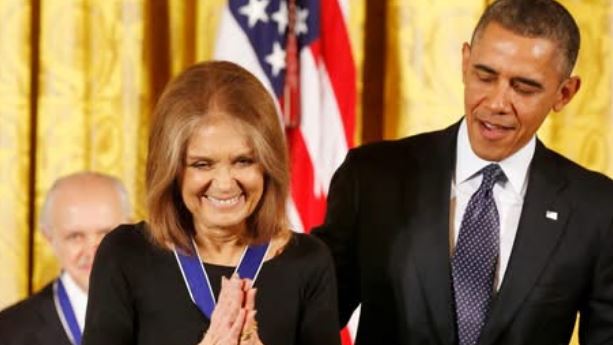
In 1993, she was inducted into the National Women’s Hall of Fame. Twenty years later, President Barack Obama awarded her the Presidential Medal of Freedom, the highest civilian honor in the United States, recognizing her leadership in the women’s movement and her work advancing civil rights.
She also received the National Civil Rights Museum’s Freedom Award in 2019 and Spain’s Princess of Asturias Award for Communication and Humanitie
Steinem viewed many of her honors not simply as recognition of her individual work, but as acknowledgment of the wider movement and the countless people who contributed to it.
Personal Life
For much of her life, Steinem was publicly skeptical of traditional marriage because of the unequal legal and social expectations historically placed on women. In 2000, at age 66, she married environmental and animal-rights activist David Bale, the father of actor Christian Bale.
Their marriage continued until Bale’s death in 2003. Steinem did not have children, but she maintained a large community of friends, colleagues, activists and younger people whom she advised and
She continued traveling, writing and participating in political life well into her later years. Despite becoming physically frail near the end of her life, people who attended one of her final gatherings said she remained mentally sharp, curious and deeply engaged with contempora
Tributes Remember a Transformational Figure
Following news of Steinem’s death, political leaders, entertainers, writers and activists shared tributes describing her influence.
Hillary Clinton, Oprah Winfrey, Jill Biden, Melinda French Gates and others remembered Steinem as a source of courage, guidance and optimism. Many emphasized that her greatest contribution was not simply becoming a famous face of feminism, but helping other women believe that their voices and experiences
For generations of Americans, Steinem represented the idea that equality required more than changes in individual attitudes. It also demanded changes in laws, workplaces, political institutions, families and media organizations.
Her critics sometimes argued that the movement she represented did not always address the needs of every woman equally. Steinem acknowledged divisions within feminist politics while continuing to advocate for a broad movement that included people of different races, economic backgrounds and identities.
A Legacy That Continues
Gloria Steinem lived long enough to witness enormous changes in American society. Women entered professions and political offices that had once largely excluded them. Public conversations about sexual harassment, domestic violence and workplace discrimination became more open. Issues once dismissed as private complaints became matters of law and national debate.
However, Steinem consistently maintained that the struggle was unfinished. She remained concerned about threats to reproductive freedom, economic inequality, violence against women and the limited representation of women in positions of power.
Her legacy survives in the organizations she helped establish, the journalism she produced and the generations of activists she encouraged. It can also be found in the everyday expectation that women should be able to speak publicly about their lives, control their futures and participate equally in society.
Gloria Steinem was not only a witness to social change. For more than six decades, she was one of the people pushing that change forward.
She leaves behind a body of writing, a network of organizations and an influence that reaches far beyond any single movement or generation. Her death marks the loss of a defining voice in American public life, but the conversations she helped begin will continue.
