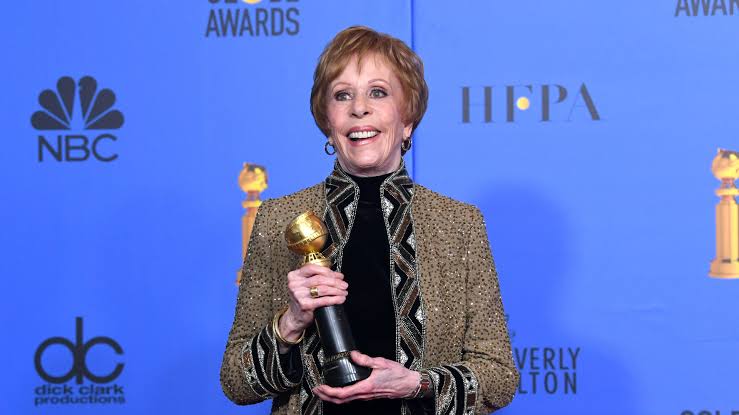
For more than seven decades, Carol Burnett has occupied a special place in American entertainment. Her unmistakable voice, expressive face, fearless physical comedy, and ability to turn even the simplest situation into something unforgettable helped make her one of television’s most recognizable performers.
Now 93 years old, Burnett remains a living connection to a remarkable era of American television.
Born Carol Creighton Burnett on April 26, 1933, in San Antonio, Texas, she built a career that crossed television, Broadway, film, music, and writing. Yet for millions of viewers, simply hearing the name Carol Burnett immediately brings back memories of laughter, elaborate costumes, celebrity guests, spontaneous moments, and a woman tugging gently on her ear as she said goodnight.
Her story, however, is about much more than comedy.
It is a story of perseverance, friendship, family, loss, reinvention, and an extraordinary ability to connect with audiences across generations.
From a Difficult Childhood to a Dream of Performing
Burnett’s childhood was far removed from the glamorous world she would eventually enter.
She was born in Texas but spent much of her youth in Hollywood, California, where she was largely raised by her grandmother. Money was often limited, and family life could be complicated.
Yet Hollywood surrounded the young Burnett with possibilities.
Movies and entertainment offered an escape, but they also planted the idea that another life might be possible.
After graduating from Hollywood High School, Burnett attended UCLA. Her original academic plans changed as she became increasingly interested in theater and performing.
There was one significant problem: moving to New York to pursue a professional career required money she did not have.
Then came one of the remarkable turns in Burnett’s early life.
An anonymous benefactor reportedly helped provide the financial support that allowed her to move to New York, with the understanding that she would someday help others if she became successful.
It was an act of generosity that helped change the direction of her life.
Finding Her Voice in New York
Success did not happen immediately.
Like countless young performers, Burnett had to audition, accept rejection and search for opportunities.
But there was something unusual about her.
She was not afraid of looking ridiculous.
Where some performers carefully protected their glamorous image, Burnett discovered that comedy became more powerful when she committed completely to a character. She could exaggerate a facial expression, throw herself across a room, sing beautifully and then destroy the elegance of the moment with perfectly timed physical comedy.
Audiences began noticing.
Her early television appearances helped introduce her to a national audience, while her performance in the Broadway musical Once Upon a Mattress in 1959 established her as an important theatrical talent.
She also became widely known through appearances on The Garry Moore Show.
By the 1960s, Burnett was no longer simply an aspiring performer.
She was becoming a star.
The Carol Burnett Show Changes Television
In 1967, The Carol Burnett Show premiered.
It would become the program most closely associated with her name and one of the defining television variety shows of its era.
The series combined sketch comedy, musical performances, celebrity appearances and direct interaction with the studio audience.
But its greatest strength was its cast.
Burnett worked alongside performers including Harvey Korman, Vicki Lawrence, Lyle Waggoner and, later, Tim Conway.
Their chemistry created something difficult to manufacture.
They genuinely seemed to enjoy making one another laugh.
Sometimes they succeeded a little too well.
One of the pleasures of watching the program was seeing professional actors struggle to maintain character when something unexpected happened. Tim Conway became particularly famous for stretching scenes to absurd lengths while Korman desperately attempted not to laugh.
Rather than destroying the comedy, those moments often made it better.
The audience felt included.
They were not simply watching actors perform a polished sketch. They were witnessing talented comedians surprising one another in real time.
Comedy Without Fear
Burnett possessed another quality that helped distinguish her.
She was willing to sacrifice vanity for a laugh.
Beautiful gowns could become ridiculous costumes. Elegant characters could transform into exaggerated caricatures. Serious movies could become outrageous parodies.
One of the show’s most famous sketches was its parody of Gone with the Wind, known as “Went with the Wind!”
Burnett appeared as Starlett O’Hara wearing an enormous curtain-inspired outfit.
The visual joke became one of the most recognizable images associated with American television comedy.
But the costume alone wasn’t what made Burnett extraordinary.
It was her commitment.
She never seemed embarrassed by comedy.
If falling down made the scene funnier, she fell down.
If an exaggerated accent worked, she used it.
If a ridiculous expression made another actor break character, she pushed further.
That willingness to look foolish required enormous confidence.
The Audience Became Part of the Show
Another important feature of The Carol Burnett Show happened before many sketches even began.
Burnett would walk onto the stage and answer questions from the studio audience.
It was unpredictable.
She could not know exactly what someone would ask.
Those conversations demonstrated one of her greatest abilities: spontaneity.
Burnett could respond quickly without making the interaction feel cruel. Her humor was sharp, but warmth remained an essential part of her personality on screen.
That relationship with viewers helped make the program feel personal.
At the end of the show came one of television’s simplest but most memorable gestures.
Burnett would tug her left ear.
It was originally a message to her grandmother—a quiet way of saying that everything was okay and that she loved her.
Eventually, millions of viewers recognized the gesture.
Something deeply personal had become part of American popular culture.
More Than a Television Comedian
Although The Carol Burnett Show became her signature achievement, Burnett never allowed herself to be confined to one format.
She performed on Broadway.
She acted in movies.
She appeared in television dramas and comedies.
She sang.
She wrote.
She demonstrated repeatedly that the performer known for exaggerated characters and slapstick comedy could also deliver emotionally complex performances.
Movie audiences may remember her particularly well as Miss Hannigan in the 1982 film adaptation of Annie.
Burnett transformed the bitter orphanage supervisor into an unforgettable comic villain.
Other film work included The Four Seasons, A Wedding and Noises Off.
Television remained central to her career, however, and Burnett continued making guest appearances long after her legendary variety show ended.
Success Could Not Protect Her From Loss
Behind the laughter, Burnett also experienced profound personal tragedy.
She was the mother of three daughters: Carrie Hamilton, Jody Hamilton and Erin Hamilton.
Carrie became an actress, singer and writer and developed an especially close creative relationship with her mother.
Carrie died in 2002 at only 38 years old after battling cancer.
The loss was devastating.
Burnett has spoken publicly over the years about grief and about continuing forward after losing her daughter.
That part of her life reveals something important about her longevity.
Carol Burnett’s public identity has always been associated with laughter, but her life has contained significant hardship.
Her humor did not mean that sadness was absent.
Both existed together.
Perhaps that is one reason audiences have remained connected to her for so long.
She never seemed like a distant celebrity manufactured entirely by television.
She seemed human.
A Career That Refused to End
Many performers become permanently associated with one period of their lives.
Burnett could easily have retired and allowed The Carol Burnett Show to define her legacy.
Instead, she continued working.
Generations who were born decades after her television variety show ended encountered her through later television appearances, streaming services, interviews and classic clips circulating online.
Then came another major role.
Burnett joined the cast of Apple TV’s Palm Royale, appearing as Norma Dellacorte alongside performers including Kristen Wiig, Laura Dern, Allison Janney, Ricky Martin and Josh Lucas.
The series introduced Burnett to yet another generation.
Her involvement was not simply ceremonial.
Norma became part of the show’s strange, glamorous and frequently outrageous world of Palm Beach society.
Burnett returned for the second season, which premiered in November 2025. Apple’s official episode information shows her appearing during the season, including its January 2026 episodes.
At an age when most people have been retired for decades, Burnett was still appearing alongside some of Hollywood’s most recognizable contemporary performers.
Carol Burnett and Vicki Lawrence: A Friendship With an Extraordinary Beginning
One of the most remarkable relationships connected to Burnett’s career is her friendship with Vicki Lawrence.
Their story began long before Lawrence became famous.
Lawrence was still young when she wrote to Burnett after people noticed their resemblance. Burnett eventually contacted her and went to see her perform.
That unusual encounter ultimately helped open a door for Lawrence.
She joined The Carol Burnett Show when the program launched in 1967 and became an essential member of the cast.
Decades later, the relationship has endured.
In September 2026, Lawrence again told the remarkable story of how Burnett personally contacted her after receiving her letter—an encounter that ultimately developed into a professional partnership and long friendship.
It is one of those Hollywood stories that sounds almost fictional.
A young admirer writes to a famous entertainer.
The entertainer actually responds.
Then the young admirer eventually becomes part of the star’s television family.
Why Carol Burnett Still Matters
Entertainment has changed dramatically since Burnett first appeared on television.
The three-network era disappeared.
Streaming transformed viewing habits.
Social media shortened the distance between celebrities and audiences.
Comedy itself changed.
Yet Burnett’s work continues to attract viewers.
Part of the explanation is craftsmanship.
Great physical comedy does not require viewers to understand every cultural reference. A perfectly timed expression, awkward silence or performer desperately trying not to laugh can remain funny decades later.
Another reason is Burnett’s generosity as a performer.
She never needed every joke to belong to her.
She surrounded herself with extremely talented people and allowed them room to shine.
That is particularly visible when watching scenes with Tim Conway and Harvey Korman.
Burnett understood that the strongest comedy ensemble was not necessarily one in which the star dominated every moment.
Sometimes the funniest thing she could do was react.
Seven Decades in Entertainment
Burnett’s professional career stretches across more than seven decades.
Think about what that means.
She performed when black-and-white television was still common.
She became a household name during the golden age of American variety television.
She worked through the rise of cable television, home video, DVDs, digital entertainment and eventually streaming.
And she remained recognizable throughout all of it.
Apple describes Burnett as an American actress, comedian and singer whose credits range from The Carol Burnett Show and Annie to Palm Royale.
Few entertainers maintain that kind of cultural visibility across so many technological and generational changes.
Honors for an Extraordinary Career
Burnett’s influence has been recognized through numerous major honors during her lifetime.
Her career has brought Emmy recognition and many other entertainment-industry awards.
She received the Presidential Medal of Freedom in 2005.
In 2013, she received the Mark Twain Prize for American Humor.
She later received the Screen Actors Guild Life Achievement Award.
Another remarkable tribute arrived when the Golden Globe Awards created the Carol Burnett Award, honoring outstanding contributions to television.
Having a major entertainment award named after you while you are still alive is a rare distinction.
But perhaps her greatest honor cannot be measured with trophies.
It is the number of comedians and actors who grew up watching her.
The Woman Behind the Laughter
Celebrity culture often encourages audiences to imagine stars as permanently young.
Carol Burnett’s career tells a different story.
She has allowed audiences to see her move through the stages of life.
Young Broadway performer.
Television superstar.
Movie actress.
Mother.
Author.
Comedy elder stateswoman.
And now a performer in her nineties whose work is being discovered by people who weren’t alive when The Carol Burnett Show originally aired.
There is something meaningful about that longevity.
It reminds us that creativity does not necessarily have an expiration date.
At 93, Her Legacy Is Still Growing
Carol Burnett turned 93 on April 26, 2026.
That number represents an extraordinary lifetime, but it does not fully explain her significance.
Her importance is found in individual moments.
A child watching an old sketch with a grandparent.
A comedian studying her timing.
A viewer discovering The Carol Burnett Show for the first time.
A longtime fan recognizing that famous ear tug.
Or a younger audience seeing Norma Dellacorte in Palm Royale without initially realizing that the actress on screen helped reshape American television decades earlier.
Her career connects generations.
More Than Nostalgia
It would be easy to describe Carol Burnett simply as a beloved figure from television history.
That description is incomplete.
Her legacy isn’t valuable merely because people feel nostalgic about an earlier era.
Burnett helped demonstrate what a woman could accomplish at the center of a major television comedy program. She showed that female comedians did not need to choose between being glamorous and ridiculous, musical and physical, vulnerable and commanding.
She could be all of those things.
And she could run the show.
Her influence can still be seen in sketch comedy, variety television and performers who combine character work with physical comedy.
A Final Thought
Carol Burnett spent much of her life giving audiences permission to laugh.
Sometimes the laughter came from an elaborate costume.
Sometimes it came from a perfectly delivered line.
Sometimes it came because Tim Conway had completely destroyed everyone else’s ability to remain in character.
And sometimes all Burnett needed was one expression.
Yet behind those moments was a performer who survived disappointment, family hardship, professional uncertainty and heartbreaking loss.
She continued.
That may ultimately be the most powerful part of her story.
At 93, Carol Burnett represents far more than the television era that made her famous. She represents endurance, creativity, generosity and the strange ability of laughter to connect people who may be separated by decades.
The television screens have changed.
The entertainment industry has changed.
The audiences have changed.
But somewhere, someone is still discovering Carol Burnett for the first time.
And somewhere else, a longtime viewer is watching her tug her ear again and remembering exactly how it felt to see it all those years ago.
Carol Burnett didn’t simply make generations of Americans laugh. She created memories that generations continue to share.
