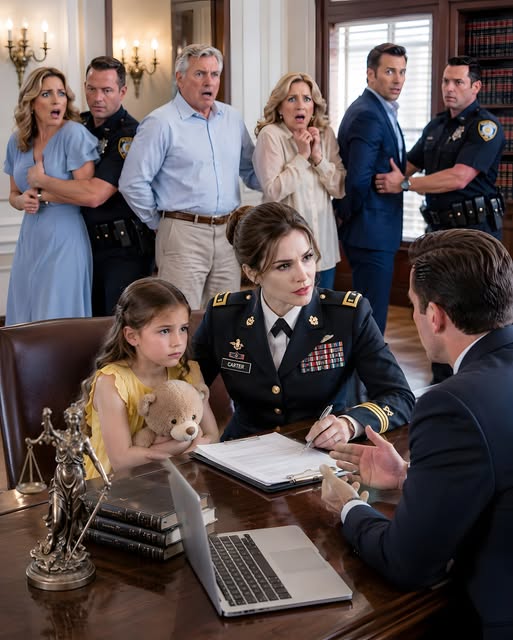
Mom continued.
“I panicked.”
“You restrained me while Ruby was unconscious.”
Her eyes filled.
“I was afraid you were going to hurt Vanessa.”
“Why?”
“Because you were furious.”
“My child was on the floor.”
“I know.”
“No, Mom. You don’t get to say that yet.”
She stared at me.
“I was trying to keep things from getting worse.”
I spoke quietly.
“For whom?”
She opened her mouth.
Closed it.
I waited.
That was another thing command had taught me.
Silence made people show you what they actually believed.
Finally she whispered, “Everyone.”
“No.”
She looked at me.
“You were protecting Vanessa.”
“I was trying to protect both my daughters.”
“You left one daughter fighting to reach her injured child while you protected the other from consequences.”
Her face broke.
Ruby turned from the television.
“Grandma?”
Mom wiped her cheeks quickly.
“I’m okay, sweetheart.”
Ruby studied her.
Then, with the simple generosity of a child who had not yet learned how adults complicated everything, she held out her applesauce.
“Do you want some?”
My mother covered her mouth.
“No, baby. Thank you.”
She stood.
“I should go.”
At the door, she turned toward me.
“I’m sorry.”
I believed she meant it.
That did not mean I trusted it.
Those were different things.
“I heard you,” I said.
She nodded.
Then left.
Dad called shortly afterward.
I did not answer.
He called again.
Then sent a text.
This has gone too far. Vanessa needs help, not jail.
I stared at it.
A second message came.
You know how your sister is.
I read that one twice.
Then I typed:
Yes. I finally do.
I turned the phone off.
Ruby was discharged the following afternoon.
The doctors gave me a thick packet of instructions.
Medication schedule.
Warning signs.
Follow-up appointments.
Rest.
Limited activity.
Nothing frightening.
Nothing dramatic.
Just care.
That was what I wanted.
Care.
Major Patel drove down from Fort Sheridan in civilian clothes to take us home.
I protested.
He ignored me.
“Ma’am, with respect, you are terrible at accepting logistical support.”
“I can drive.”
“You have slept four hours.”
“I’ve driven on less.”
“That is not the persuasive argument you think it is.”
Ruby giggled from the wheelchair.
“You’re in trouble, Mom.”
I looked at her.
“Apparently.”
Patel crouched beside her.
“I brought you something.”
He produced a small canvas bag.
Inside was a children’s book, colored pencils, and a stuffed golden retriever wearing a tiny Army patrol cap.
Ruby’s eyes widened.
“Is he a soldier?”
“Absolutely.”
“What’s his rank?”
Patel glanced at me.
“Specialist.”
“Why not colonel?”
“Colonel seemed taken.”
Ruby hugged the stuffed dog.
“What’s his name?”
“That’s your assignment.”
She considered the matter with total seriousness.
“Sergeant Waffles.”
Patel looked impressed.
“Outstanding.”
“He’s not a sergeant,” I said.
Ruby frowned.
“He got promoted.”
Patel nodded gravely.
“Field promotion. Completely valid.”
For the first time since the weekend began, I laughed without immediately feeling guilty for it.
The drive home took longer because Patel stopped twice.
Ruby slept most of the way.
I watched the highway pass through the window.
Bare trees.
Gas stations.
Farm fields turning bronze beneath the late afternoon sun.
My phone remained off.
It felt strange.
For twenty years, I had trained myself to be reachable.
Commanders.
Soldiers.
Schools.
Doctors.
Family.
There was always someone who might need me.
But that afternoon, the world could wait.
Ruby woke near the state line.
“Mom?”
“I’m here.”
“Are we almost home?”
“Two hours.”
“That’s not almost.”
“Fair point.”
She hugged Sergeant Waffles.
Then asked, “Are we still family with Grandma?”
The question caught me.
Children had a way of finding the exact thing adults wanted to postpone.
“Yes,” I said carefully.
“What about Aunt Vanessa?”
I looked back at her.
“She’s still related to us.”
“That’s not what I asked.”
Patel stared straight ahead.
I nearly smiled.
“No,” I said. “It isn’t.”
Ruby waited.
I chose my words carefully.
“Being family means more than being related. It also means making people feel safe and cared for.”
“Grandma loves me.”
“Yes.”
“Did she do a bad thing?”
“Yes.”
Ruby looked down at the stuffed dog.
“Can people do a bad thing and still love you?”
I swallowed.
“Yes.”
“Then what happens?”
Sometimes I wondered why anyone thought military command was complicated.
Six-year-olds asked harder questions than generals.
“You see if they understand what they did,” I said. “And if they change.”
Ruby thought about that.
“Do we have to forgive them?”
“No.”
“Never?”
“You never have to decide before you’re ready.”
She nodded.
Then she asked Patel, “Does Sergeant Waffles have snacks?”
Patel said, “Naturally.”
The moment passed.
But the question stayed with me.
Do we have to forgive them?
I had spent half my childhood believing forgiveness meant returning everything to the way it was.
No consequences.
No boundaries.
No memory.
That was not forgiveness.
That was surrender wearing a nicer name.
The first week home revolved around Ruby.
Follow-up appointments.
Movies on the couch.
Macaroni and cheese.
Calls from her teacher.
A visit from her best friend Maya, who brought stickers and spent forty minutes discussing whether mermaids could become astronauts.
The ordinary things helped.
At night, Ruby sometimes asked me to leave the hallway light on.
I did.
Once she woke from a bad dream.
I sat beside her until she fell asleep again.
I did not ask for details.
The child psychologist the hospital recommended had told me something important.
“Give her language if she wants it. Don’t make her relive what she isn’t trying to explain.”
So I listened.
When she wanted to talk, we talked.
When she wanted to color, we colored.
When she wanted to argue that breakfast cereal was technically appropriate for dinner because both were “meals,” we argued about that instead.
My command conference was postponed.
General Reeves called once.
Not about work.
“How’s your daughter?”
“Better.”
“And you?”
“Functional.”
He chuckled.
“That is the most colonel answer I’ve ever heard.”
“I’m working on it.”
“Good.”
Then he said, “Carter, I need to tell you something before you hear it somewhere else.”
My stomach tightened.
“What?”
“Someone contacted public affairs asking whether the Army intends to intervene in a family criminal matter involving a senior officer.”
I sat down.
“Who?”
“We don’t know yet.”
I thought immediately of my father.
Or Vanessa’s attorney.
“What did public affairs say?”
“The truth. The Army is not involved in the criminal investigation. I visited because one of my senior officers had a family emergency.”
I closed my eyes.
“I’m sorry, sir.”
“For what?”
“This becoming your problem.”
“It isn’t.”
“But—”
“Stop.”
I did.
His voice remained calm.
“You are allowed to have a private life, Carter. You are allowed to have a family crisis. Your rank does not require you to become less human.”
I stared at the kitchen table in my own house.
Not my parents’ table.
Mine.
A bowl of apples sat in the center.
Ruby’s crayons were scattered near the edge.
“I understand.”
“No, you don’t.”
I almost smiled.
He continued.
“You think because you command soldiers, you should command every part of your life equally well. That is not how life works.”
“Yes, sir.”
“Also, whoever contacted public affairs may be hoping the appearance of professional embarrassment will pressure you.”
My jaw tightened.
“It won’t.”
“I know.”
That was why he called.
Not to warn me away.
To remind me that someone else’s attempt at pressure did not create an obligation.
After we hung up, I turned my phone over.
There were three voicemails from Dad.
One from Mom.
None from Vanessa.
She had been released pending court proceedings under conditions that included no contact with Ruby.
I listened to Dad’s first voicemail.
“Emma, you need to think about what this is doing to your mother.”
Delete.
Second.
“Vanessa has lost her job because of all this.”
Delete.
Third.
“We’re still a family whether you like it or not.”
I did not delete that one.
I listened again.
Then saved it.
Not because I wanted evidence.
Because for the first time, I heard the sentence differently.
We’re still a family whether you like it or not.
He meant obligation.
I heard choice.
Families continued only in the forms people were willing to maintain.
My mother came to see me two weeks later.
She called first.
That was new.
“Can I visit?”
I looked at Ruby, who was building a cardboard castle in the living room.
“Alone?”
“Yes.”
“Dad isn’t coming?”
“No.”
I hesitated.
“Okay.”
When Mom arrived, she looked older.
She carried no casseroles.
No gifts.
No dramatic peace offering.
Just her purse.
Ruby hugged her.
I watched carefully.
Mom did not hold on too long.
Another small thing.
<!–nextpage–>
Another thing I noticed.
After Ruby went upstairs to get a book, Mom sat across from me.
“I started seeing someone.”
I blinked.
“What?”
“A therapist.”
That was not where I expected the sentence to go.
“Dad knows?”
“He thinks I’m overreacting.”
“Of course he does.”
Mom almost smiled.
Then her expression grew serious.
“I watched the video.”
I said nothing.
“The detective let us view it with our attorney.”
Her hands trembled slightly.
“I had been telling myself I grabbed you because I was scared.”
“You were scared.”
“Yes.”
She looked at me.
“But I was scared of the wrong person.”
I felt my throat tighten.
Mom continued.
“I saw myself run to Vanessa.”
I waited.
“I saw Ruby on the floor, and I went to Vanessa.”
Her voice broke.
“I don’t know how I became that person.”
I did.
But I wanted her to find the answer herself.
So I remained quiet.
She stared at her hands.
“When you girls were little, Vanessa was difficult.”
I almost laughed.
“Difficult.”
“I know.”
She sighed.
“That word is part of the problem.”
There it was.
A beginning.
“She had terrible tantrums,” Mom said. “Your father thought discipline would make them worse. So we learned to avoid setting her off.”
“We all learned.”
“Yes.”
“You made me give up my birthday party when I was thirteen because she said she hated the restaurant.”
Mom closed her eyes.
“I remember.”
“You told me I was mature enough to compromise.”
“I remember.”
“You gave her my graduation dinner reservation because she wanted that restaurant for her anniversary.”
“I remember.”
“You asked me not to bring Ruby home for Christmas two years ago because Vanessa said children were too noisy.”
Mom’s eyes filled.
“I remember all of it.”
I leaned back.
“What I don’t understand is why it took this.”
“I don’t either.”
We sat with that.
No excuse would have made it better.
Maybe the absence of an excuse was better.
Mom wiped her eyes.
“My therapist asked me why I was always asking you to be the reasonable one.”
I waited.
“She said sometimes parents confuse the child who can tolerate disappointment with the child who should.”
I looked away.
That one hurt.
Mom continued.
“You were always strong.”
“No.”
She frowned.
“I wasn’t strong. I was trained.”
Her face changed.
I had never said that aloud before.
Not even to myself.
“You rewarded me for needing less.”
Mom whispered, “Yes.”
“And punished me when I finally needed something.”
“Yes.”
The answer came so quietly that I almost missed it.
Ruby came downstairs holding a picture book.
“Grandma, will you read?”
Mom looked at me first.
Not asking permission in a performative way.
Checking.
I nodded.
She sat on the couch.
Ruby climbed beside her.
I watched my mother read about a bear looking for a missing hat.
Her voice shook at first.
Then steadied.
For thirty minutes, nothing was fixed.
But nothing was being denied either.
That felt new.
Three days later, Detective Ortiz called.
“We completed a broader review of the home video system.”
I frowned.
“Broader?”
“The kitchen camera automatically saves motion-triggered clips for thirty days.”
I sat down at my desk.
“What did you find?”
“There are several earlier recordings involving your sister.”
My stomach tightened.
“Ruby?”
“No.”
Relief came first.
Then concern.
“Who?”
“Your mother.”
I stared at the wall.
“What do you mean?”
“I’d rather not describe everything over the phone. None of the clips show what happened to Ruby. But they do show a pattern of volatile confrontations.”
I felt suddenly cold.
“Did Mom know the system was recording them?”
“Probably not.”
“What kind of confrontations?”
“Arguments. Your sister throwing objects onto counters. Blocking your mother’s path during one disagreement. Your mother repeatedly attempting to calm her.”
I closed my eyes.
There it was.
The family system preserved digitally.
Not one terrible afternoon.
Years compressed into habits.
“What happens with the recordings?”
“They may be relevant as context, but that depends on the prosecutor.”
I thought about my mother sitting in my living room saying, I don’t know how I became that person.
Maybe she had become that person slowly.
One surrender at a time.
Ortiz hesitated.
“There is something else.”
“What?”
“One clip is dated three nights before your visit.”
I waited.
“Your parents and Vanessa are discussing your upcoming weekend.”
My pulse slowed.
“What about it?”
“I think you should hear it directly before drawing conclusions.”
“Why?”
“Because your name comes up.”
I gripped the phone.
“What do they say?”
Ortiz paused.
Then answered carefully.
“Your sister tells your parents that she doesn’t want you visiting anymore.”
That alone would not have surprised me.
“What else?”
“Your father tells her to tolerate the weekend because, in his words, ‘Emma always leaves when things get uncomfortable.’”
I said nothing.
Ortiz continued.
“Your mother says Ruby was looking forward to seeing them.”
My throat tightened.
“And Vanessa?”
“She says something I want you to interpret for yourself.”
“What?”
Another pause.
“She says, ‘Then they both need to learn whose house this is.’”
I stared at Ruby’s crayons on the kitchen counter.
Not a threat.
Not exactly.
But not nothing either.
“What did my parents say?”
“Your mother told her not to talk that way.”
“And Dad?”
“He changed the subject.”
I closed my eyes.
That was somehow the most familiar part.
Change the subject.
Wait for the anger to pass.
Make dinner.
Move on.
Ortiz lowered her voice.
“Colonel Carter, I’m not telling you this to frighten you. I’m telling you because the prosecution may ask whether there was an established family pattern.”
“There was.”
The words came before I could reconsider them.
“Yes,” I said again. “There was.”
After we hung up, I sat alone for several minutes.
Then Mom called.
I almost ignored it.
But something made me answer.
“Emma?”
“Yes.”
Her voice sounded strange.
“Your father left.”
I sat straighter.
“What do you mean?”
“He packed a suitcase.”
“Where did he go?”
“I don’t know.”
“Did you have an argument?”
“No.”
A pause.
Then she corrected herself.
“Yes.”
“What happened?”
“I told him I wasn’t going to help Vanessa avoid responsibility anymore.”
I waited.
Mom continued.
“He said I was choosing you over the family.”
I closed my eyes.
“And what did you say?”
Her answer surprised me.
“I told him choosing truth wasn’t choosing sides.”
Silence.
Then she added, “He said I had changed.”
A faint, exhausted laugh escaped her.
“I told him I hoped so.”
I leaned back in my chair.
For the first time in my life, my mother sounded frightened and steady at the same time.
“Are you safe?”
“Yes.”
“Do you want me to come?”
“No.”
The answer was immediate.
Then softer:
“I think I need to learn how to sit in a quiet house without running after whoever is angry.”
I pressed my lips together.
That sounded like something a therapist had helped her find.
Or maybe something she had always known and finally said aloud.
“All right.”
“Emma?”
“Yes?”
“I found something.”
“What?”
“A box in the attic.”
I waited.
“It has letters in it.”
“What kind of letters?”
“From you.”
I frowned.
“I never wrote you letters.”
“Not to me.”
Her voice became very quiet.
“You wrote them to Dad.”
I sat completely still.
“When?”
“Basic training. Officer Candidate School. Your first deployment. There are dozens.”
I remembered some of them.
Letters home.
Years before email became ordinary.
Pages written in barracks rooms and airport terminals.
I had assumed they were lost.
“What about them?”
Mom took a breath.
“There are notes on the envelopes.”
“Notes?”
“In your father’s handwriting.”
My chest tightened.
“What do they say?”
She hesitated.
Then read one.
“Emma wants praise again. Don’t encourage drama.”
I closed my eyes.
Another:
“Promoted. She’ll get overexcited if we make too much of it.”
My throat went dry.
Mom continued.
“There are more.”
“Stop.”
She stopped immediately.
I stood and walked to the window.
Outside, Ruby was drawing with sidewalk chalk under the supervision of our neighbor.
Safe.
Laughing.
Normal.
“Why would he write that?”
Mom began crying.
“I don’t know.”
I did.
At least I thought I did.
For years I had believed my parents simply did not understand my career.
Maybe Dad had understood more than I thought.
Maybe not the ranks or assignments.
But enough to know that recognition mattered to me.
Enough to deliberately withhold it.
“Emma,” Mom said.
“Yes?”
“There’s one letter he never opened.”
I turned away from the window.
“What?”
“It’s still sealed.”
“From when?”
She read the postmark.
Twenty years earlier.
The year everything between my father and me changed.
The year I stopped asking him whether he was proud of me.
“What does it say on the envelope?” I asked.
Mom was silent for so long I thought the call had dropped.
Then she whispered:
“In your handwriting, it says, ‘Dad, please read this one.’”
I closed my eyes.
And suddenly, the mystery was no longer only about Vanessa.
It was about the family that had taught all of us who was allowed to need something—and who was not.
