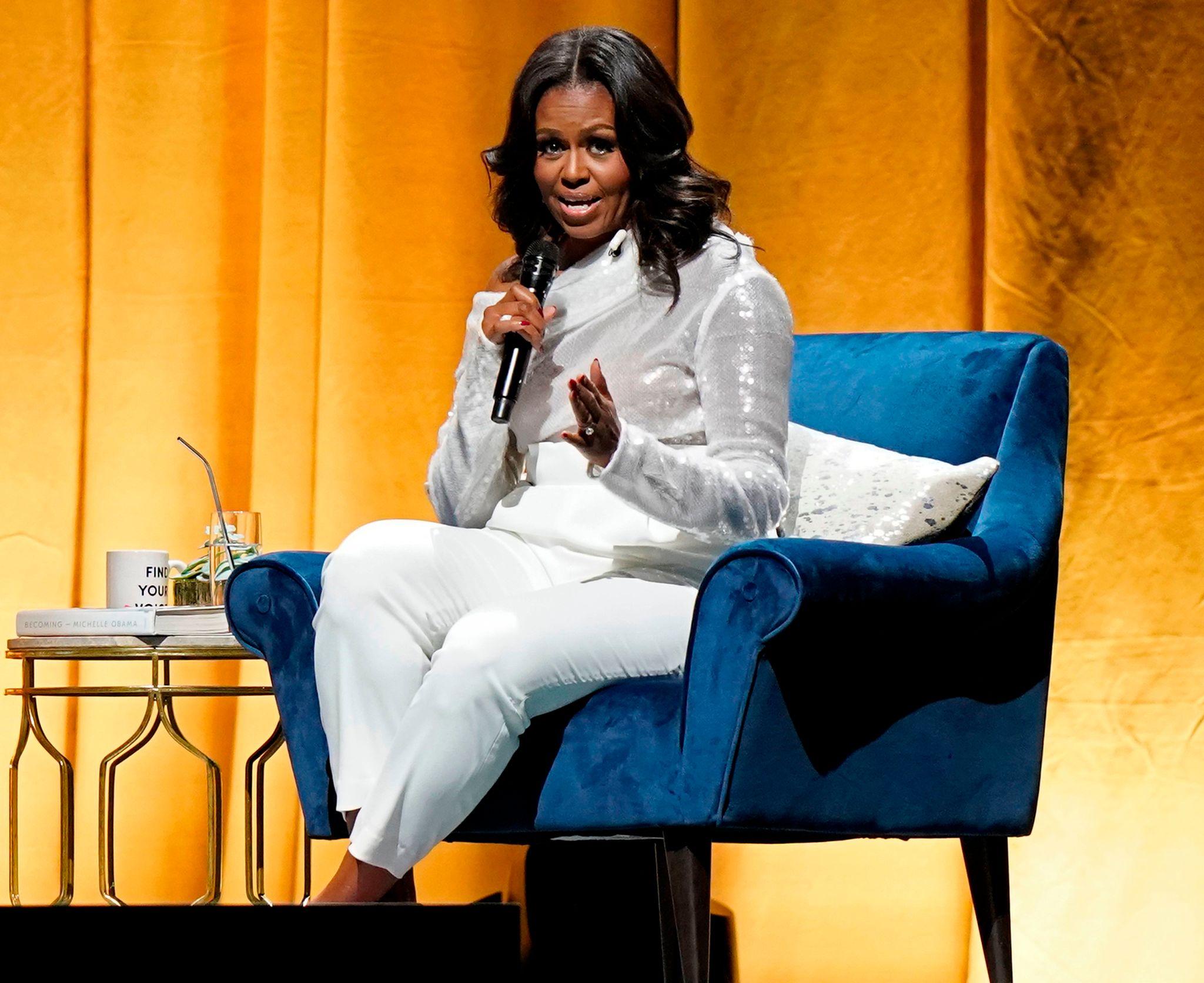
The inspiring life story of a woman who overcame expectations, made history as First Lady, and discovered that her greatest influence could extend far beyond the White House.

The Girl Who Never Imagined Living in the White House
Before the elegant gowns, the presidential ceremonies, the international recognition, and the millions of people who would come to admire her, Michelle Obama was simply a young girl growing up on the South Side of Chicago.
She lived in a modest home with her parents and older brother, surrounded by the ordinary routines of a working-class American family. Her childhood was not filled with luxury, political connections, or promises of extraordinary fame.
Yet the little girl who once shared a bedroom with her brother would eventually become the First Lady of the United States, a bestselling author, a mother raising two daughters under intense public scrutiny, and an internationally recognized advocate for education, health, and opportunity.
Her journey was not always easy.
She encountered racial and gender stereotypes, navigated demanding academic environments, balanced professional ambitions with family responsibilities, and endured years of public criticism.
But what makes Michelle Obama’s story especially compelling is that she did not become influential simply because she married a future president.
Long before the White House, she had already built an impressive career through education, discipline, and determination.
And after leaving Washington, she continued developing a public identity that was distinctly her own.
Her life offers a powerful reminder that where a person begins does not have to determine how far that person can go.
A Childhood Built on Love, Discipline, and Determination
Michelle LaVaughn Robinson Obama was born on January 17, 1964, in Chicago, Illinois.
Her father, Fraser Robinson III, worked for the city’s water department, while her mother, Marian Shields Robinson, helped create a stable and supportive home for Michelle and her older brother, Craig.
The Robinson family lived in an upstairs apartment in a house belonging to relatives in Chicago’s South Shore neighborhood.
Their home was modest, but education, responsibility, and family relationships were central to everyday life.
Michelle’s parents encouraged their children to ask questions, express their opinions, and take their education seriously.
One of the most significant influences in Michelle’s childhood was her father’s determination.
Fraser Robinson lived with multiple sclerosis, a chronic neurological disease that gradually affected his mobility. Despite the physical challenges, he continued working and supporting his family.
Watching her father confront difficulties without surrendering his responsibilities helped shape Michelle’s understanding of perseverance.
Her mother was equally important.
Marian Robinson provided emotional stability, practical guidance, and the reassurance that her children deserved to pursue ambitious goals.
Michelle later described how her parents created an environment in which she and Craig felt heard and valued.
The family did not have enormous financial resources, but Michelle grew up understanding that education could create opportunities unavailable to previous generations.
That belief would influence nearly every major decision she made.
The Student Who Refused to Lower Her Expectations
From an early age, Michelle demonstrated strong academic abilities.
She attended Chicago public schools and eventually enrolled at Whitney M. Young Magnet High School, a competitive institution known for its demanding academic programs.
Getting to school required a lengthy commute, but she remained focused on her studies.
She worked hard, developed confidence in her abilities, and began imagining a future beyond the neighborhood where she had grown up.
However, her ambitions were not always met with encouragement.
In her memoir, Michelle recalled being discouraged from applying to Princeton University by a school counselor who questioned whether she was suited for the institution.
Rather than allowing that assessment to determine her future, she applied.
She was accepted.
In 1981, Michelle Robinson entered Princeton University, where she encountered a world very different from the one she had known in Chicago.
The university offered extraordinary academic opportunities, but she also became increasingly aware of the racial and socioeconomic differences between herself and many classmates.
As a Black woman attending a predominantly white elite institution, she sometimes felt pressure to prove that she belonged.
Instead of abandoning her ambitions, she completed her studies and graduated in 1985 with a degree in sociology and a certificate in African American studies.
Her senior thesis explored the experiences of Black Princeton alumni and their relationships with the university community.
The subject reflected her growing interest in identity, belonging, and the ways institutions influence people’s opportunities.
After Princeton, she attended Harvard Law School, earning her law degree in 1988.
For a young woman whose parents had never attended college, graduating from two of America’s most prestigious universities represented an extraordinary achievement.
But her story was only beginning.
Building a Career Before Becoming Famous
After graduating from Harvard Law School, Michelle Robinson returned to Chicago and joined Sidley & Austin, a prominent law firm.
She was entering a profession known for demanding hours, intense competition, and considerable pressure.
For many young attorneys, obtaining a position at a prestigious firm represented the ultimate professional achievement.
Michelle had worked extraordinarily hard to reach that point.
Yet she gradually began questioning whether corporate law was the career she truly wanted.
She was successful by conventional standards, but professional prestige alone did not provide the sense of purpose she was searching for.
She wanted her work to have a more direct impact on communities and people.
That realization eventually encouraged her to pursue public service and community development.
She worked in Chicago city government, became involved with nonprofit organizations, and later held leadership positions at the University of Chicago and the University of Chicago Medical Center.
Her work included helping young people develop leadership skills, strengthening community relationships, and expanding opportunities for individuals who might otherwise struggle to find professional pathways.
These experiences were important because they established Michelle Obama as an accomplished professional long before she became a nationally recognized political figure.
She was not simply preparing to become someone’s wife.
She was developing her own ambitions, values, and understanding of what meaningful success looked like.
The Unexpected Love Story That Changed Her Life
At Sidley & Austin, she was assigned to mentor a summer associate named Barack Obama.
Barack was a Harvard Law student working at the firm during the summer.
Michelle was initially hesitant about dating someone from her workplace.
She was focused on her career, and a romantic relationship with a colleague did not seem like a particularly sensible idea.
But Barack was persistent, and the two gradually developed a connection.
Their relationship grew through conversations about family, community, personal ambitions, and their shared belief that public service could make a meaningful difference.
Although their personalities and backgrounds differed in certain ways, they found common ground in their values.
Michelle admired Barack’s intelligence and his commitment to helping others.
Barack appreciated Michelle’s confidence, discipline, and strong sense of identity.
Their relationship eventually became serious.
On October 3, 1992, Michelle Robinson and Barack Obama married in Chicago.
At the time, neither could have known that their marriage would one day become one of the most closely watched relationships in American political history.
They were two ambitious young professionals beginning their life together.
Their future would include career changes, parenthood, financial pressures, political campaigns, and eventually the extraordinary responsibilities of the presidency.
But like many couples, they would also have to learn how to balance individual dreams with shared responsibilities.
Motherhood, Marriage, and the Challenges Behind the Public Image
Michelle and Barack welcomed their first daughter, Malia, in 1998.
Their second daughter, Sasha, was born in 2001.
Motherhood brought enormous joy into Michelle’s life, but it also introduced new responsibilities and challenges.
In her memoir Becoming, she wrote openly about experiencing a miscarriage and later using in vitro fertilization to conceive her daughters.
By discussing those experiences publicly, she helped bring attention to reproductive difficulties that many families experience privately.
She also described the challenges of balancing motherhood with professional responsibilities and a marriage increasingly affected by Barack’s political career.
As Barack became more involved in politics, his work frequently required travel and long periods away from home.
Michelle continued working while managing much of the family’s daily routine.
There were times when the arrangement created frustration.
Rather than presenting their marriage as permanently effortless, Michelle later spoke about the importance of communication, counseling, compromise, and adapting to different stages of life.
That openness challenged the idea that a successful marriage must always appear perfect.
Their relationship, like many others, required effort.
For Michelle, becoming a mother also changed the way she thought about ambition.
Professional achievement remained important, but so did being present for her daughters.
She wanted Malia and Sasha to grow up feeling secure, supported, and loved, regardless of what happened in their father’s political career.
Those priorities would become even more important when the Obama family entered the national spotlight.
The Historic Election That Changed Everything
On November 4, 2008, Barack Obama won the United States presidential election.
The victory was historic.
He became the first African American elected president of the United States.
Michelle Obama was preparing to become the nation’s first African American First Lady.
For millions of Americans, the moment represented a profound milestone in the country’s history.
But for Michelle, it also marked the beginning of an enormous personal transition.
The woman who had grown up in a modest Chicago apartment was about to move into the White House.
Her husband would become one of the most powerful political leaders in the world.
Her daughters would grow up surrounded by Secret Service protection, public attention, and extraordinary expectations.
And Michelle herself would become a highly visible figure whose clothing, speeches, parenting choices, and public appearances would be examined by millions.
On January 20, 2009, Barack Obama was inaugurated as the 44th president of the United States.
Michelle stood beside him as the country entered a new chapter.
She was 45 years old.
Although the occasion was filled with celebration, it also carried tremendous responsibility.
She understood that her role would be about much more than attending ceremonies and welcoming international guests.
She wanted to use her position to make a meaningful difference.
Life Inside the White House Was Not Always Easy
From the outside, life in the White House might appear glamorous.
There are elegant rooms, historic furnishings, formal dinners, beautiful gardens, and opportunities to meet influential people from around the world.
But Michelle Obama has explained that the experience also involved restrictions and sacrifices.
The family’s movements were carefully coordinated.
Security requirements affected ordinary activities.
Even simple outings required planning.
For Malia and Sasha, growing up in the White House meant living in a place that was both a family home and a major institution of government.
Michelle worked to preserve as much normalcy as possible.
She encouraged her daughters to focus on school, friendships, responsibilities, and family routines.
Her mother, Marian Robinson, moved into the White House to help provide stability and support.
Having their grandmother nearby helped Malia and Sasha maintain a close connection to the family life they had known before Washington.
Michelle also continued emphasizing the importance of ordinary household expectations.
Despite their unusual surroundings, the girls were still children who needed guidance, structure, and opportunities to develop independence.
For Michelle, the White House was not simply a symbol of power.
It was also the place where she was raising her daughters during some of the most important years of their lives.
Fighting for Healthier Children Across America
One of Michelle Obama’s most recognized initiatives as First Lady was the Let’s Move! campaign, launched in 2010.
The initiative focused on improving children’s health and addressing childhood obesity.
Michelle believed that healthier eating habits, increased physical activity, and better access to nutritious food could help children build stronger foundations for adulthood.
The campaign encouraged families, schools, community organizations, and businesses to participate.
It promoted physical activity, nutrition education, and healthier school environments.
Michelle also helped establish a vegetable garden on the White House grounds.
Children visited to learn about growing vegetables, understanding food, and making nutritious choices.
Her efforts also intersected with broader debates about school meals, nutrition standards, and the role of government in public health.
Not everyone agreed with every policy associated with these efforts.
Some critics raised concerns about costs, implementation, food choices, and government involvement.
Nevertheless, the campaign helped make childhood nutrition and physical activity prominent subjects of national conversation.
For Michelle, the issue was personal.
As a mother, she understood how busy family schedules, limited resources, and everyday pressures could influence children’s health.
She wanted families to have more information and better opportunities to make healthy choices.
Becoming a Voice for Girls and Women’s Education
Education had transformed Michelle Obama’s own life.
It helped her move from a working-class neighborhood in Chicago to Princeton, Harvard, and eventually the White House.
She understood how access to education could open doors.
As First Lady, she encouraged young people to take school seriously and pursue opportunities even when they faced discouragement.
Her Reach Higher initiative, launched in 2014, promoted education and training beyond high school.
The initiative emphasized college preparation, career training, and the importance of completing postsecondary education.
In 2015, Michelle and Barack Obama launched Let Girls Learn, an initiative focused on helping adolescent girls around the world access education.
The effort highlighted obstacles including poverty, discrimination, violence, and limited educational resources.
Michelle used her international visibility to draw attention to the potential of girls who were being denied opportunities.
Her message was rooted in her own experiences.
She knew what it meant to encounter doubts about her abilities.
She also knew how much could change when a young person received encouragement instead of discouragement.
Throughout her public appearances, she repeatedly urged students not to allow other people’s expectations to define their futures.
For young women in particular, her story became an example of what education, persistence, and self-confidence could make possible.
The Pressure of Being America’s First Black First Lady
Michelle Obama’s time in the White House also came with intense public scrutiny.
As the first Black woman to hold the position of First Lady, she occupied a unique place in American history.
Her public image was shaped not only by political disagreements but also by conversations about race, gender, identity, and expectations of women in public life.
She faced criticism about her appearance, personality, statements, and activities.
Some attacks relied on racist or sexist stereotypes.
At the same time, she became an admired public figure for many Americans who appreciated her speaking style, family-centered priorities, and advocacy work.
Michelle frequently emphasized dignity and self-respect when responding to public hostility.
During the 2016 Democratic National Convention, she delivered one of her best-known speeches.
Her statement, “When they go low, we go high,” became a widely repeated expression of her approach to public conflict.
The phrase reflected her belief that responding to hostility with additional hostility was not always the most constructive choice.
Her political influence grew considerably during Barack Obama’s presidency.
Although she did not hold elected office, she became an important campaign speaker and an influential voice within the Democratic Party.
She also remained a public figure whose views attracted both support and criticism.
Her legacy, therefore, cannot be understood only through admiration.
It also reflects the complicated expectations placed on women, especially Black women, who occupy prominent positions in American public life.
Leaving the White House and Beginning a New Chapter
On January 20, 2017, Barack Obama’s presidency ended.
After eight years, Michelle Obama was no longer First Lady.
For many people, leaving such an influential position might have represented the end of a remarkable public career.
For Michelle, it became an opportunity to explore a new stage of her life.
She had spent years balancing the responsibilities of the White House with her commitment to raising her daughters.
Now she had greater freedom to decide how she wanted to spend her time and use her influence.
She could write, speak, develop projects, and participate in public discussions without the daily obligations of being First Lady.
The transition also gave her an opportunity to reflect on her personal identity.
Who was Michelle Obama beyond the titles of attorney, wife, mother, and First Lady?
What did she want the next chapter of her life to represent?
Those questions would become central to one of her most successful projects.
Becoming: The Book That Introduced a More Personal Michelle Obama
In November 2018, Michelle Obama released her memoir, Becoming.
The book became an international bestseller and introduced readers to a deeply personal account of her life.
Rather than focusing exclusively on politics, Michelle explored her childhood, education, career, marriage, motherhood, and years in the White House.
She wrote about insecurities, disappointments, difficult decisions, and moments when she questioned whether she was making the right choices.
She also discussed experiences that had rarely been shared publicly.
Readers learned about her family’s financial limitations, the influence of her parents, her professional dissatisfaction, her fertility struggles, and the challenges of maintaining a marriage while living under extraordinary pressure.
The memoir’s appeal came partly from its willingness to show vulnerability.
Michelle did not portray herself as someone who had always possessed perfect confidence.
Instead, she described confidence as something developed through experience.
She explained how identity changes over time and how people can continue growing even after achieving goals they once considered impossible.
The book’s title captured that central idea.
Becoming suggested that personal growth is not a destination reached once and for all.
It is an ongoing process.
The success of the memoir led to an extensive book tour and a Netflix documentary, also titled Becoming.
Through these projects, Michelle reached audiences beyond traditional political circles.
Many readers connected with her experiences as a daughter, student, working woman, wife, and mother.
Her story reminded them that public success does not eliminate private uncertainty.
Finding Strength During Difficult Times
In 2022, Michelle released another book, The Light We Carry.
Where Becoming explored her personal journey, The Light We Carry focused more directly on the ways people navigate uncertainty, fear, and change.
The book addressed relationships, confidence, community, and emotional resilience.
Michelle discussed the importance of maintaining supportive connections and developing practical habits that help people cope with difficult circumstances.
She also shared reflections on how uncertainty affects individuals and families.
Her writing resonated with readers who had experienced disruption, loneliness, and anxiety during the COVID-19 pandemic and other periods of instability.
The book reinforced a message that had become central to her public identity.
Strength does not necessarily mean being fearless.
It can mean acknowledging uncertainty while continuing to move forward.
Michelle’s willingness to discuss emotional challenges helped broaden her public role beyond politics.
She increasingly became known as an author and speaker who explored personal development, relationships, and the pressures of modern life.
A Marriage That Has Grown Through Different Seasons
Their appearances together have often been celebrated, but Michelle has repeatedly explained that marriage involves more than romantic photographs and public celebrations.
She has spoken about periods when their relationship required significant adjustment.
Their careers placed different demands on their time.
Raising children introduced new responsibilities.
Political life brought public scrutiny and prolonged separations.
Michelle has emphasized that a lasting partnership requires patience, communication, and a willingness to recognize that two people may experience the same circumstances differently.
She has also challenged the unrealistic expectation that marriage should always feel equally satisfying at every moment.
Her comments have sometimes generated controversy, particularly when short excerpts circulated without the broader context of her discussions.
But her central message has generally been that strong relationships are built through sustained effort rather than permanent perfection.
After decades together, Michelle and Barack have experienced several distinct stages of life: young professionals, parents of small children, a presidential family, and eventually parents of adult daughters.
Each stage has required them to redefine routines and responsibilities.
Their marriage has become part of Michelle’s broader story about change, resilience, and the importance of maintaining an individual identity within a partnership.
Raising Two Daughters Away From the Spotlight
For Michelle Obama, motherhood has remained one of the most meaningful parts of her life.
Malia and Sasha spent important years of their childhood living in the White House.
Millions of people watched them grow up through occasional public appearances and family photographs.
But Michelle and Barack worked to protect their daughters’ privacy and allow them to develop independent lives.
After the presidency, the family entered a new phase.
Malia and Sasha pursued their education, friendships, careers, and personal interests outside the daily routines of the White House.
Michelle has spoken about the emotional transition of watching children become adults.
Parenting young children often involves direct supervision, schedules, and constant decision-making.
Parenting adult children requires a different kind of trust.
For Michelle, part of that transition meant learning to step back and allow her daughters to make their own choices.
She has expressed pride in the people they are becoming while continuing to emphasize the importance of family relationships.
Despite her public accomplishments, she has often described raising her daughters as one of her most important responsibilities.
Her perspective reflects a theme that runs throughout her life: professional success and personal relationships do not have to be competing measures of worth.
Both can be meaningful, even when balancing them is difficult.
The Woman Behind the Public Image
Michelle Obama is often photographed in beautiful clothing, speaking before large audiences, or attending important international events.
Her style has attracted significant attention.
She has appeared on magazine covers, influenced fashion trends, and become associated with a polished but approachable public image.
Yet the most interesting parts of her story are not necessarily found in those photographs.
They are found in the choices she made when no cameras were watching.
The choice to pursue Princeton despite discouragement.
The decision to leave a prestigious legal career because she wanted more meaningful work.
The effort to build a marriage while maintaining her professional identity.
The determination to protect her daughters’ childhood during an extraordinary period of public attention.
And the willingness to discuss experiences that might make her appear vulnerable.
These decisions reveal a person whose life has been shaped by ambition, responsibility, uncertainty, and change.
Michelle has never claimed that her path should serve as a perfect model for everyone.
Her circumstances are unusual, and her opportunities eventually became extraordinary.
But many of the questions she has confronted are familiar.
How do people define success?
How do they balance their ambitions with family responsibilities?
How do they respond when others underestimate them?
And how can they continue developing a sense of purpose after reaching a major life goal?
Those questions help explain why her story continues to attract attention.
Why Michelle Obama’s Legacy Extends Beyond Politics
Michelle Obama will always be remembered as a historic First Lady.
Her eight years in the White House represented an important chapter in American political and cultural history.
But limiting her legacy to that position would overlook much of what she accomplished before and afterward.
Her career has included law, public administration, nonprofit leadership, hospital administration, writing, media production, and public advocacy.
Through Let’s Move!, she helped bring attention to children’s health.
Through Reach Higher, she encouraged young people to pursue further education.
Through Let Girls Learn, she advocated for educational opportunities for girls internationally.
Through her books, she introduced millions of readers to her personal experiences and reflections.
She and Barack also established Higher Ground Productions, developing film, television, and audio projects.
These activities have allowed Michelle to remain active in public life without seeking elected office herself.
Her influence is especially visible among people who see aspects of their own experiences reflected in her journey.
For some, she represents the possibilities created by education.
For others, she represents the challenges of balancing professional ambition and motherhood.
For many Black women and girls, her historic role in the White House carries particular cultural significance.
And for readers who have struggled with uncertainty, her openness about personal growth offers another kind of connection.
Of course, Michelle Obama remains a political figure whose statements and associations generate disagreement.
Her public role is inseparable from the broader debates surrounding the Obama presidency and American politics.
But her cultural influence also reaches beyond those debates.
Her life story continues to invite conversations about education, family, opportunity, identity, and the meaning of success.
The Lasting Lessons of Michelle Obama’s Extraordinary Journey
When Michelle Obama was a little girl in Chicago, she could not have predicted the life awaiting her.
She did not know she would attend Princeton and Harvard.
She did not know she would meet a young law student who would eventually become president.
She did not know she would raise her daughters in one of the most famous residences in the world.
And she could not have known that millions of people would eventually read her books and listen to her speeches.
What she did know was that her parents believed in education, hard work, and treating people with dignity.
Those values became a foundation she carried into adulthood.
Her journey illustrates that success rarely follows a perfectly straight path.
She achieved professional milestones and then questioned whether they were right for her.
She built a family while navigating demanding careers.
She entered the White House with significant responsibilities and left with new opportunities.
She experienced public admiration and harsh criticism.
And she continued searching for purpose even after reaching a level of recognition that few people ever experience.
Perhaps the most important lesson of her life is that identity does not have to be fixed.
A person can be ambitious and uncertain.
Successful and still learning.
Confident and occasionally afraid.
A devoted parent and an independent professional.
Michelle Obama’s life has contained all of those experiences.
Final Thoughts: From Chicago’s South Side to the World Stage
It is about a young girl whose family taught her to believe in her potential, a student who refused to let discouragement determine her future, and a professional who discovered that meaningful work mattered more to her than prestige alone.
It is also about a wife and mother who navigated the extraordinary pressures of political life while trying to preserve the values that had shaped her childhood.
And it is about a woman who continued building a public career after leaving one of the world’s most visible positions.
Her journey has not been without criticism, challenges, or difficult decisions.
But it demonstrates how education, supportive relationships, determination, and a willingness to grow can shape an extraordinary life.
From a modest apartment in Chicago to the halls of Princeton and Harvard, from a law office to the White House, and from the presidency’s spotlight to a successful career as an author and public advocate, Michelle Obama has experienced transformations that once would have seemed unimaginable.
Her story continues to resonate because it is not simply about reaching the highest levels of society.
It is about what a person chooses to do with the opportunities they receive.
And perhaps that is why, long after her years as First Lady ended, Michelle Obama remains such a recognizable figure.
She is a reminder that the beginning of someone’s story does not have to define its ending.
Sometimes, the girl who grows up in a small apartment with big dreams becomes the woman whose story encourages millions of others to dream bigger, too.
