
NEW YORK — Peter Max, the influential artist whose brilliant colors, cosmic imagery and unmistakable psychedelic designs became visual symbols of the 1960s “flower power” movement, has died at the age of 88.
Max died Monday after living for years with advanced dementia, according to a written statement released by his son, Adam Max. A specific cause of death was not disclosed.
For more than six decades, Max’s joyful artwork reached far beyond museums and private galleries. His colorful suns, stars, flowers, rainbows, planets and human figures appeared on posters, postage stamps, clothing, household products, airplanes and even the exterior of a cruise ship.
His designs were also commissioned for some of the world’s most recognizable sporting and cultural events. Max served as an official artist for the Olympics, the Super Bowl, the Indianapolis 500, the World Cup and the World Series. His portrait subjects included musicians, actors, American presidents and contemporary stars such as Taylor Swift.
“We will remember his extraordinary creativity, his warmth, his curiosity, and the way he saw beauty and possibility everywhere,” Adam Max said in the family’s announcement. “His art became part of American culture, but the man behind that art — the father we knew and loved — is the person we will miss most.”
The artist’s death closes a remarkable chapter in American popular culture. Max was not simply a successful painter or designer. At the height of his career, his images became part of the visual language of an entire generation.
The artist who gave “flower power” its colors
During the late 1960s and early 1970s, Max’s work was nearly impossible to avoid. His posters decorated bedrooms, college dormitories and music shops across the United States. His designs appeared on clocks, bedsheets, scarves, mugs, dresses, neckties and numerous other products.
The images were optimistic, energetic and instantly recognizable. Max frequently combined bold outlines with glowing combinations of orange, turquoise, yellow, purple, red and neon green. His compositions featured smiling faces, celestial landscapes, floating figures and imaginary worlds that seemed to exist somewhere between a dream, a comic book and outer space.
His art captured the excitement of a period when young Americans were challenging traditional ideas about politics, war, music, spirituality and personal freedom. Although he did not invent psychedelic art, Max helped bring its colors and symbols into mainstream American homes.
Unlike artwork intended primarily for galleries and wealthy collectors, his creations were widely reproduced and relatively accessible. A young person who could not afford an original painting could still own a Peter Max poster, book or household item.
That accessibility contributed to his extraordinary popularity, but it also made his relationship with the traditional art establishment complicated. Some critics viewed his commercial success with suspicion. Others believed that the widespread reproduction of his images distracted from his abilities as a painter and graphic designer.
Nevertheless, Max’s cultural influence proved difficult to dismiss. His work was displayed in museums and galleries around the world, and the Museum of Modern Art in New York acquired several of his pieces.
An extraordinary journey from Berlin to New York
Peter Max Finkelstein was born in Berlin in 1937 to a Jewish family. His childhood unfolded against the growing danger of Nazi Germany. When he was still a baby, his parents fled the country and took him to Shanghai, where the family lived for about a decade.
Shanghai exposed the young Max to a mixture of cultures, architecture, color and religious traditions. He later recalled being fascinated by the movement and visual beauty he observed around a Buddhist temple near his family’s home.
The family subsequently lived in Israel and spent time in Paris before moving to New York City when Max was 16. By then, he had developed a fascination with American culture, particularly jazz, Hollywood films and comic books.
New York offered him an opportunity to turn that fascination into a career. He studied at the Art Students League and also attended the School of Visual Arts and Pratt Institute. Although he would eventually become famous for imaginative, psychedelic compositions, his training included traditional drawing and realism.
That technical foundation remained important throughout his career. Beneath the bright colors and seemingly spontaneous shapes was an artist who had studied composition, anatomy and classical methods.
In the early 1960s, Max established a Manhattan graphic-design studio with his friend Tom Daly. Their work combined illustration, photography, collage and advertising techniques. The studio quickly attracted attention from publishers, corporations and advertising agencies searching for a new visual identity appropriate for a rapidly changing decade.
Max’s interest in astronomy played a major role in the development of what he called his “Cosmic ’60s” period. Planets, stars and limitless skies became recurring elements in his art, reflecting both the era’s space-age excitement and its interest in spiritual exploration.
His visibility expanded rapidly. He appeared on television and was featured on the cover of Life magazine in 1969, smiling beneath his signature dark mustache. By that point, Peter Max had become more than an artist’s name—he was a recognizable cultural brand.
Success that became overwhelming
Max’s commercial success resulted in an enormous licensing operation. His designs appeared across dozens of product categories, bringing his artwork to millions of people.
He later acknowledged that the operation became so extensive that he felt his creativity was being overtaken by merchandising. Max said he had reached a point when he was spending too little time painting and too much time managing the business surrounding his name.
In the early 1970s, he temporarily withdrew from much of his commercial activity. The decision allowed him to return to the studio and reconnect with painting as a personal artistic practice.
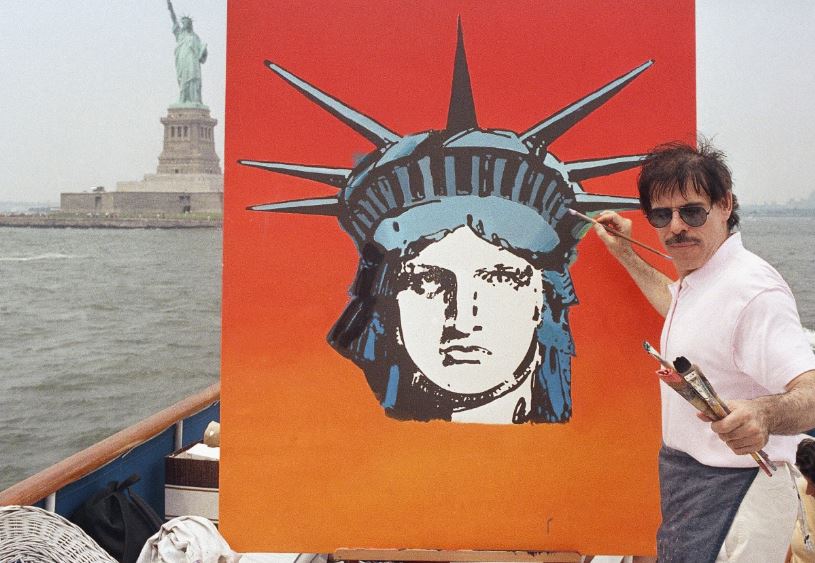
When he returned to public life, he began working on projects that combined his popular appeal with national symbols and major public events. One of the most important subjects of this period was the Statue of Liberty.
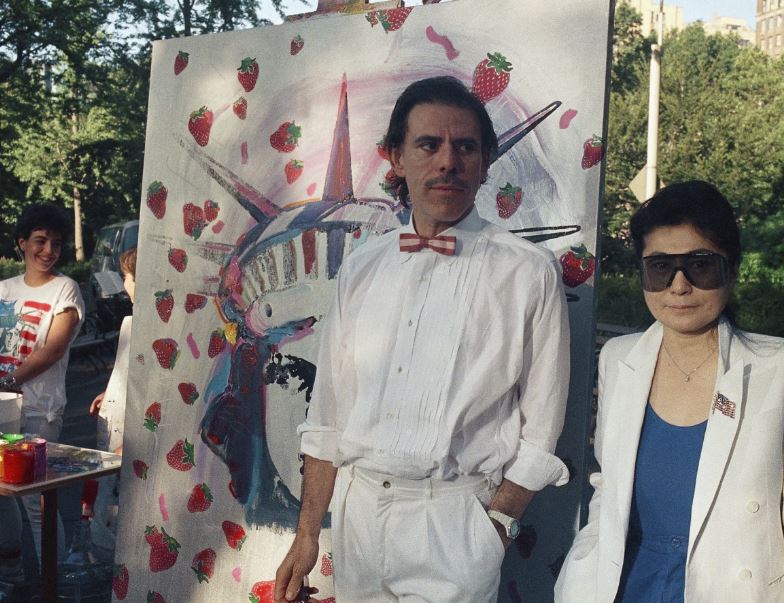
Max created numerous interpretations of the monument, presenting it not in traditional gray-green tones but through explosive combinations of color. The statue became an ideal subject for him because it represented immigration, freedom and reinvention—themes closely connected to his own family’s journey.
In 1981, first lady Nancy Reagan invited him to paint at the White House as part of his continuing Statue of Liberty project. Max also supported efforts associated with restoring the monument, further connecting his artistic identity with one of America’s most famous landmarks.
Art on airplanes, ships and sporting stages
Max’s willingness to place art outside conventional galleries made him a natural choice for large public commissions. His designs appeared on a Continental Airlines Boeing 777 and on a Norwegian Cruise Line vessel, transforming massive forms of transportation into moving works of art.
He also created commemorative images connected to international sports. These commissions allowed Max to apply his energetic style to events built around movement, celebration and shared public experience.
His art became associated with major Super Bowls, Olympic Games, the 1994 World Cup, baseball’s World Series and the Indianapolis 500. Through those projects, his work reached audiences who might rarely visit a museum or purchase fine art.
Max worked in numerous formats during his career, including painting, drawing, collage, sculpture, printmaking and digital imagery. Although his techniques evolved, his commitment to vivid color remained consistent.
He also produced portraits of political leaders, athletes and entertainers. His subjects included U.S. presidents and some of the most recognizable cultural figures of their eras.
Confusion surrounding “Yellow Submarine”
Because Max’s style closely resembled the psychedelic imagery associated with the Beatles’ 1968 animated film Yellow Submarine, many people assumed that he created its famous visual designs.
The film’s principal artistic credit, however, belongs to German illustrator Heinz Edelmann. Max offered varying accounts concerning whether he had performed early consulting work connected to the project, but he was not the credited designer of the finished movie or its album cover.
The persistent misunderstanding demonstrated how strongly the public associated Max with the look of the psychedelic era. Even artwork he did not create was sometimes attributed to him because its colors, shapes and playful surrealism appeared to belong to the visual world he helped popularize.
Max did have personal connections with the Beatles and other major figures in music and entertainment. His art frequently reflected the same interests in peace, spirituality and expanded consciousness that appeared throughout the decade’s music.
Spirituality, peace and an optimistic worldview
Eastern philosophy and spirituality were important influences on Max’s life. He helped bring spiritual teacher Swami Satchidananda Saraswati to the United States, where Satchidananda became an influential figure in the growth of yoga and Eastern spiritual practices.
Ideas of peace, unity and universal connection repeatedly appeared in Max’s work. His images were rarely dominated by anger or despair. Instead, they invited viewers into an idealized universe filled with color and possibility.
He explained that he deliberately avoided concentrating on negative subjects in his paintings. His artistic world favored harmony, natural beauty and emotional uplift, even when the real world around him was experiencing conflict.
That philosophy helped his work remain popular long after the historical peak of the hippie movement. Viewers did not need specialized knowledge of art history to understand his images. Their emotional message was immediate: energy, freedom, imagination and hope.
Max once summarized his perspective by saying that he viewed the world through “rainbow eyes.” The phrase became an especially fitting description of both his style and public identity.
Controversies and difficult final years
Max’s life was not always as bright as his paintings.
In 1997, he pleaded guilty to tax fraud after federal authorities alleged that he had concealed more than $1 million in income from the sale of his artwork. He was initially sentenced to two months in prison but was later permitted to participate in a work-release arrangement.
He paid back taxes and a $30,000 fine and was ordered to complete 800 hours of community service. Max performed part of that service by teaching art to students in Harlem schools.
His later years were overshadowed by declining health and disputes involving his family, guardianship and the management of his artwork and finances.
The disagreements became public in 2015 amid competing allegations involving Max’s second wife, Mary, and his son Adam from his first marriage. Accounts of legal proceedings described the artist as increasingly frail.
In 2019, Mary Max died by suicide, shortly after The New York Times published an investigation examining Max’s dementia, guardianship and the continued sale of artwork bearing his name. The situation raised difficult questions about the protection of aging artists, the authenticity and production of commercially sold artwork, and who should control an artist’s legacy when that person can no longer manage his affairs.
These painful episodes contrasted sharply with the joyful world Max presented on canvas. They also added complexity to the final period of a life often publicly defined by light, color and optimism.
A legacy larger than the 1960s
Although Max will always be connected to the psychedelic generation, his influence extended well beyond one decade. His career helped demonstrate how art could move fluidly among galleries, commercial advertising, entertainment, fashion and public events.
He challenged the boundary between fine art and mass culture, even when critics disagreed about where his work belonged. His willingness to license and reproduce his images made them available to an unusually large audience, transforming him into one of the most widely recognized artists of his time.
Max also created a visual form of optimism that remained identifiable for generations. Even people unfamiliar with his name could often recognize the smiling profiles, radiant skies and cosmic backgrounds associated with his work.
His life reflected many of the dramatic movements of the 20th century: escape from Nazi persecution, migration across continents, postwar American opportunity, the explosion of youth culture, commercial mass media and the growing influence of celebrity branding.
He arrived in New York as a teenager whose family had crossed the world in search of safety. Within little more than a decade, he became one of the artists most closely associated with American popular culture.
Peter Max’s first marriage, to Elizabeth Nance, ended in divorce. He is survived by his son, Adam Max, and his daughter, Libra Astro.
For admirers, his legacy will live in the public images that made city streets, bedrooms, products, sporting events and transportation vehicles feel like parts of the same radiant universe.
His most familiar works offered a simple but enduring invitation: to imagine a world brighter, more peaceful and more colorful than the one outside the frame.
Peter Max saw that possibility everywhere—and for millions of people, his art made it visible.
